What damages can I claim with a Personal Injury Claim Lawyer India?
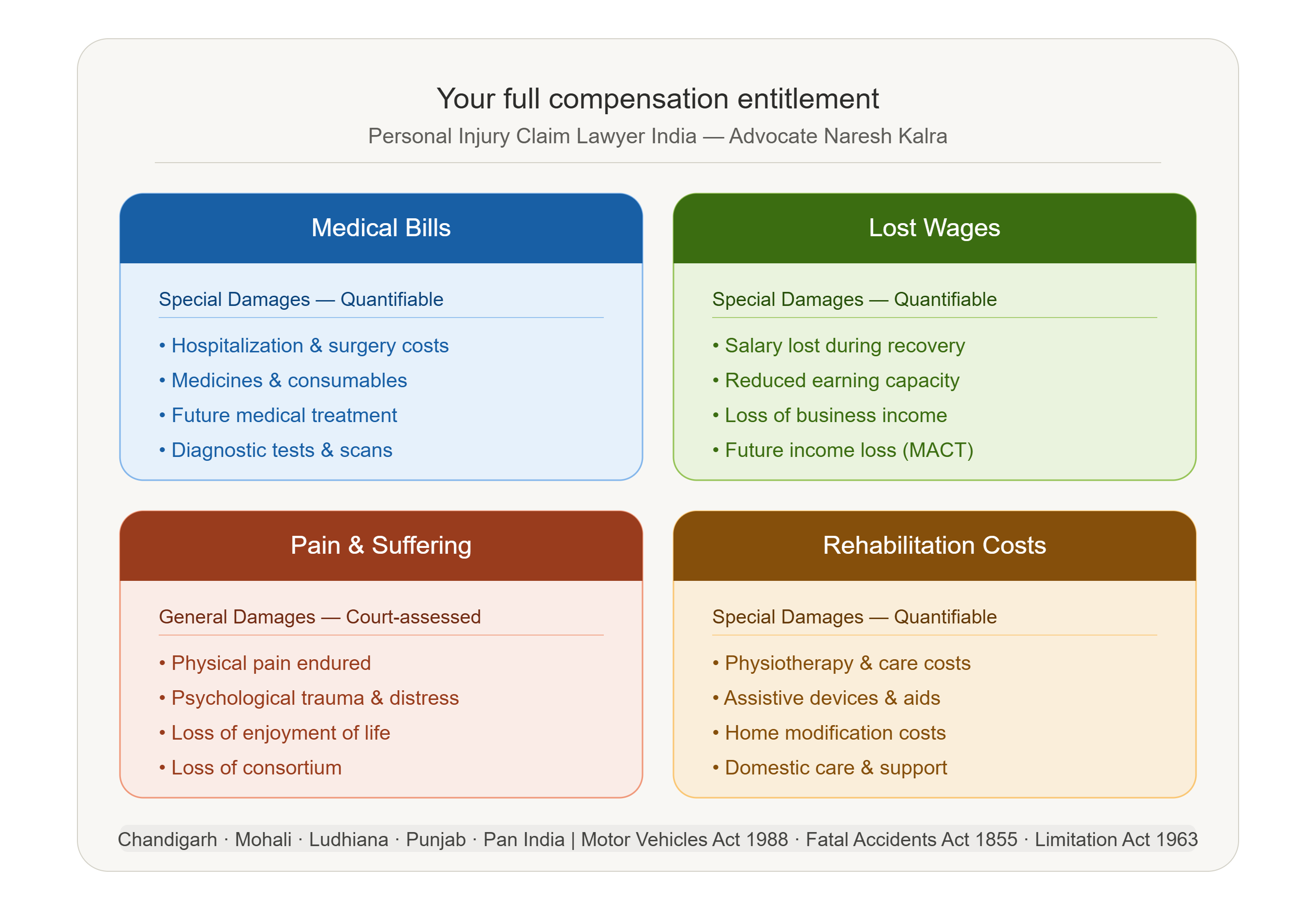
Indian courts recognize two categories of compensation. Special Damages cover your actual quantifiable losses — medical bills, hospitalization costs, medicines, lost wages, and future treatment expenses. General Damages cover subjective losses — pain and suffering, loss of enjoyment of life, psychological trauma, and loss of consortium. Our Personal Injury Advocate India team ensures every applicable head of loss is calculated and claimed, so you receive the full compensation the law entitles you to.
How long does a personal injury case take in India?
Timeline varies significantly based on the forum and complexity. MACT claims under the Motor Vehicles Act can conclude in 1–3 years in many districts. Civil suits before courts in Chandigarh, Mohali, or Ludhiana may take 2–5 years if contested. Cases with strong evidence and a reasonable defendant often settle through negotiation in 6–18 months without full trial. We always pursue the fastest route to a fair outcome — and we keep you informed at every stage.
What does a Public Liability Lawyer India do?
If you are injured on commercial or public premises — a mall, office building, hotel, park, or public road — due to poor maintenance, inadequate lighting, defective flooring, or other hazardous conditions, the property owner or managing authority is liable under public liability law. Our Public Liability Lawyer India practice investigates the defect, establishes the owner's knowledge of the risk, and pursues compensation for your medical costs, lost income, and suffering.
What is the limitation period for filing a personal injury claim?
Under the Limitation Act, 1963, most personal injury civil suits must be filed within three years from the date of injury or the date you became aware of the injury and its cause. MACT petitions under the Motor Vehicles Act have their own filing timeline, and this specific area is currently under active review — a 6-month limitation was added by a 2019 amendment, but the Supreme Court of India has that provision under constitutional challenge as of late 2025 and has directed that MACT claims not be dismissed as time-barred while the matter is pending. Filing even one day late on a general civil claim can permanently bar it, so if you have been injured, contact our offices in Chandigarh, Mohali, or Ludhiana immediately — delay is your biggest enemy.
Can I claim compensation if I was partially at fault for the accident?
Yes. Indian courts apply the principle of contributory negligence, which may reduce your compensation proportionally to your share of fault — but does not eliminate your right to claim entirely. Even if you were 30% responsible for an accident, you can still recover 70% of your damages from the other party. We counter inflated contributory negligence arguments from defendants with evidence and legal precedent.
What is the difference between a tort claim and a criminal case in India?
They are separate legal tracks that can run in parallel. A criminal case (for example, for rash and negligent driving, or medical negligence causing death) is brought by the State to punish the wrongdoer with fine or imprisonment, and it is decided on the higher "beyond reasonable doubt" standard. A tort or civil personal injury claim is brought by you, the victim, to recover monetary compensation for your loss, and it is decided on the lower "balance of probabilities" standard. Winning or losing the criminal case does not automatically decide your civil compensation claim — you can pursue a civil claim regardless of whether a criminal case is filed, succeeds, or fails.
Can I sue for mental or emotional distress alone, without a physical injury?
Indian courts do recognize civil claims for psychological harm and mental agony even without an accompanying physical injury — for instance, distress caused by witnessing a serious accident, by harassment, or by a professional's negligence. In practice, however, these claims are considerably stronger and easier to value when supported by medical or psychiatric evidence and a clear causal link to the defendant's conduct, rather than resting on emotional distress alone. We assess the strength of the available evidence honestly before advising you on this type of claim.
What is the difference between special damages and general damages?
Special damages are your actual, quantifiable financial losses — medical bills, lost wages, repair costs, and similar expenses that can be proven with documents and receipts. General damages cover subjective, non-financial losses such as pain and suffering, psychological trauma, loss of enjoyment of life, and loss of consortium, which do not have a bill attached but are still legally compensable. A full claim should include both categories, plus, where relevant, future special damages for ongoing treatment or reduced earning capacity. See the comparison table above for a fuller breakdown.
How is fault or liability determined when multiple parties are involved in an accident?
Where more than one party contributed to your injury — for example, two drivers in a multi-vehicle collision, or a contractor and a property owner in a construction-site accident — Indian courts apportion liability between the parties based on the evidence of each party's degree of fault. This can result in joint and several liability, where you may recover your full compensation from any one liable party, who can then seek contribution from the others, or in a proportionate split determined by the tribunal or court. Establishing exactly who did what requires careful evidence gathering — police reports, witness statements, CCTV footage, and expert reconstruction where needed — which is a core part of what we do in multi-party cases.
Do I need to go to court, or can a personal injury claim be settled out of court?
Many personal injury claims in India settle through negotiation or mediation without a full trial, particularly where liability is reasonably clear and both sides have complete documentation. Litigation becomes necessary when the opposite party or their insurer disputes liability, undervalues the claim, or refuses to negotiate in good faith. We always attempt a well-prepared negotiation first, since a thoroughly documented claim typically produces a better settlement offer than an incomplete one — but we take the matter to the MACT, consumer forum, or civil court without hesitation when a fair settlement is not on the table.
What happens if the person who injured me has no money or insurance?
This is a genuine practical concern, and the answer depends on the type of case. In motor accident cases, the Motor Vehicles Act requires third-party insurance, and uninsured or hit-and-run cases can often still be compensated through statutory mechanisms such as the Solatium Fund or by pursuing the vehicle owner directly. In other tort claims, if the individual defendant lacks the means to pay, we look for other potentially liable parties — an employer under vicarious liability, a property owner, a product manufacturer, or an insurer — since compensation is often recoverable from more than one source even when the direct wrongdoer cannot pay. We assess these options honestly as part of your case evaluation, before you commit to a course of action.
Do you offer a free legal consultation?
Yes. Contact Mr. Harish Tiwari from the Naresh Kalra Legal Team at +91-9815580037 to discuss your case and schedule your initial Free consultation.