Get trusted legal guidance from experienced advocates. We provide strategic legal advice, strong representation, transparent communication, and practical solutions tailored to your case with a focus on fast, effective results.
When we consult a medical professional, a surgeon, or step into a hospital, we place our lives entirely in their hands. Healthcare practitioners owe a strict legal, ethical, and professional duty of care to their patients. However, when diagnostic centers, doctors, nurses, or hospital administrators deviate from established medical standards due to carelessness, rush, or lack of proper skill, the consequences can be devastating. Medical malpractice can result in permanent physical disability, lifelong cognitive impairment, catastrophic financial drain, or the tragic wrongful death of a loved one.
At the Law Office of Advocate Naresh Kalra, a premier medical negligence law firm India, we understand that fighting a multi-specialty hospital or a well-funded medical professional can be incredibly overwhelming for a grieving family.
As leading medical negligence lawyers in India, we bridge the gap between complex medical protocols and the legal machinery. Serving Chandigarh, Ludhiana, Jalandhar, Mohali, and clients nationwide, our firm provides aggressive, technically precise, and deeply empathetic medical negligence legal representation in India to secure the justice and financial restitution you rightfully deserve. If you are searching for the best medical negligence lawyer India, our dedicated team is built to stand by your side.
How do I prove medical negligence in India? You must establish four things: that the doctor or hospital owed you a duty of care, that this duty was breached by falling below the standard a reasonably competent practitioner would have met, that the breach directly caused your injury, and that you suffered quantifiable harm as a result. In practice, this almost always requires the complete medical record (case sheets, nursing notes, operative and anesthesia records, diagnostic films) and an independent expert medical opinion confirming the deviation from accepted clinical protocol — courts in India rarely accept a claim of negligence on the patient's account alone, however genuine.
How much compensation can I get for medical negligence? There is no fixed formula — Indian courts and consumer commissions assess each case on its own facts, weighing actual and future medical costs, lost income and earning capacity, and pain, suffering, and loss of amenities. The scale can be substantial: in the landmark case of Dr. Balram Prasad v. Dr. Kunal Saha & Ors. (Supreme Court of India, 24 October 2013), the court awarded approximately ₹6.08 crore plus interest, at the time India's highest-ever medical negligence award. That figure illustrates the outer ceiling Indian courts have shown they are willing to reach in cases of proven, severe negligence — not a guarantee of what any individual case will recover, which depends entirely on your own facts, injuries, and evidence.
In Indian jurisprudence, medical negligence is categorized under the law of torts, consumer protection laws, and criminal law. Legally, negligence is defined as the failure to exercise the reasonable degree of care, skill, and caution that an ordinary, prudent, and qualified practitioner in that specific field would exercise under similar circumstances. When you hire an experienced medical negligence case lawyer India, the first step is always evaluating if your case meets the statutory definitions of malpractice.
The Supreme Court of India's most influential ruling on this exact question is Kusum Sharma v. Batra Hospital & Medical Research Centre, (2010) 3 SCC 480, decided on 10 February 2010. The Court laid down a detailed set of guidelines — often cited as an eleven-point test — for telling genuine negligence apart from a mere error of clinical judgment, and confirmed that a doctor is judged against a "reasonable body of medical opinion" in their field, the Indian application of the English Bolam standard. In simple terms: a doctor is not negligent simply because a different, equally competent doctor might have chosen a different course of treatment, or because a recognized medical procedure carried an inherent risk that materialized despite reasonable care. Negligence exists only where the conduct falls below what a responsible, similarly qualified professional would have done in the same circumstances — and this is precisely the line a doctor negligence lawyer India must draw with evidence, not assumption.
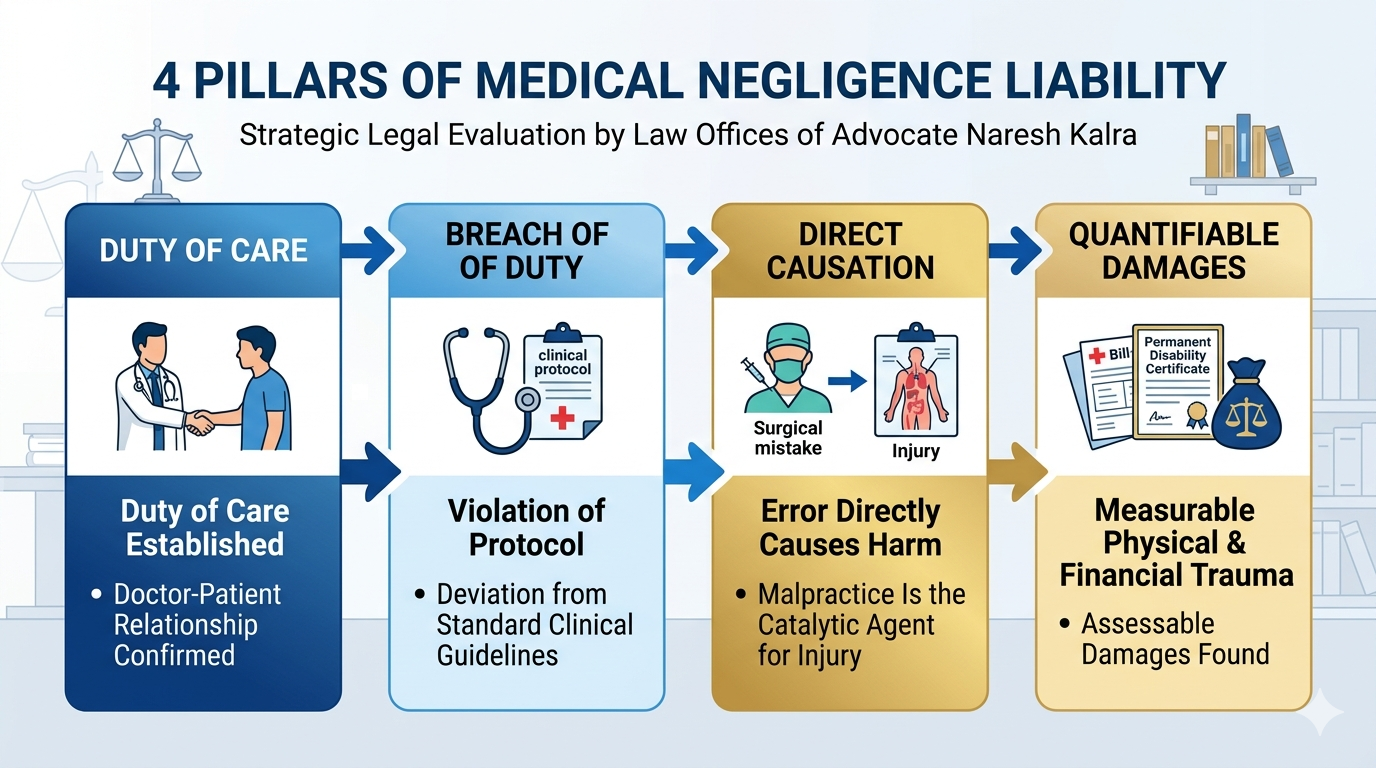
To build a foolproof medical negligence compensation claim India, our legal team systematically establishes the four foundational pillars of liability, often referred to as the "Four Ds" of medical malpractice
The existence of a formal doctor-patient relationship must be established. Once a physician agrees to examine, diagnose, or treat a patient, or once a hospital admits a patient, a statutory and contractual duty of care is automatically initiated.
This is the core of your legal action. With the assistance of a seasoned medical negligence lawyer India, we must prove that the healthcare provider deviated from standard clinical guidelines, operational protocols, or accepted modes of treatment. The question the court asks is: "Did the doctor do something that a reasonably competent doctor would never have done, or did they fail to do something a competent doctor would have done?"
Proving a mistake is not enough; we must establish a direct causal link between the doctor’s specific error and the injury suffered by the patient. A specialized doctor negligence lawyer India knows how to prove that the complication or death was not a natural progression of the underlying disease, but a direct result of clinical oversight.
The patient or their family must have suffered measurable harm. This includes physical pain, additional corrective surgeries, permanent loss of an organ or bodily function, loss of employment, or emotional trauma.
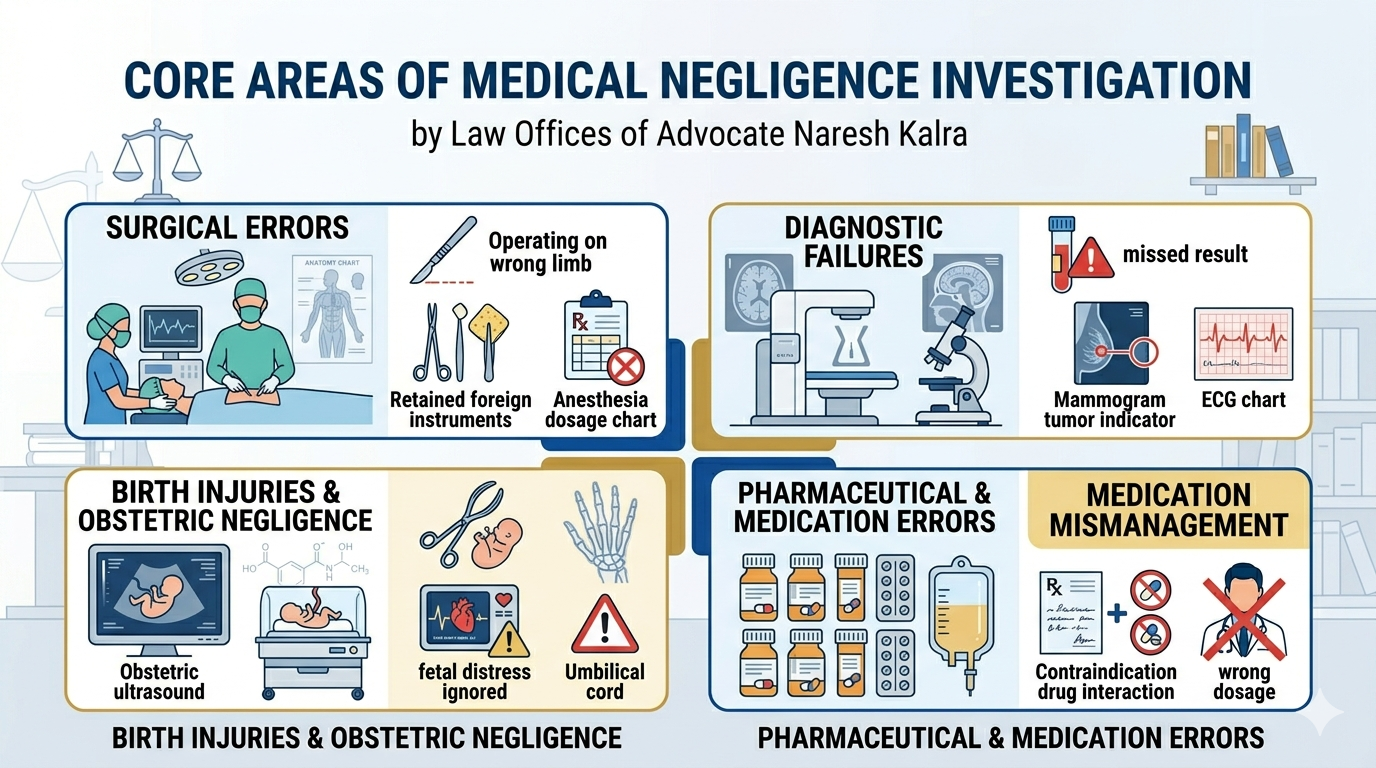
Medical negligence manifests in various departments of healthcare. As a versatile hospital malpractice lawyer India, our team conducts deep-dive investigations into the following core operational areas
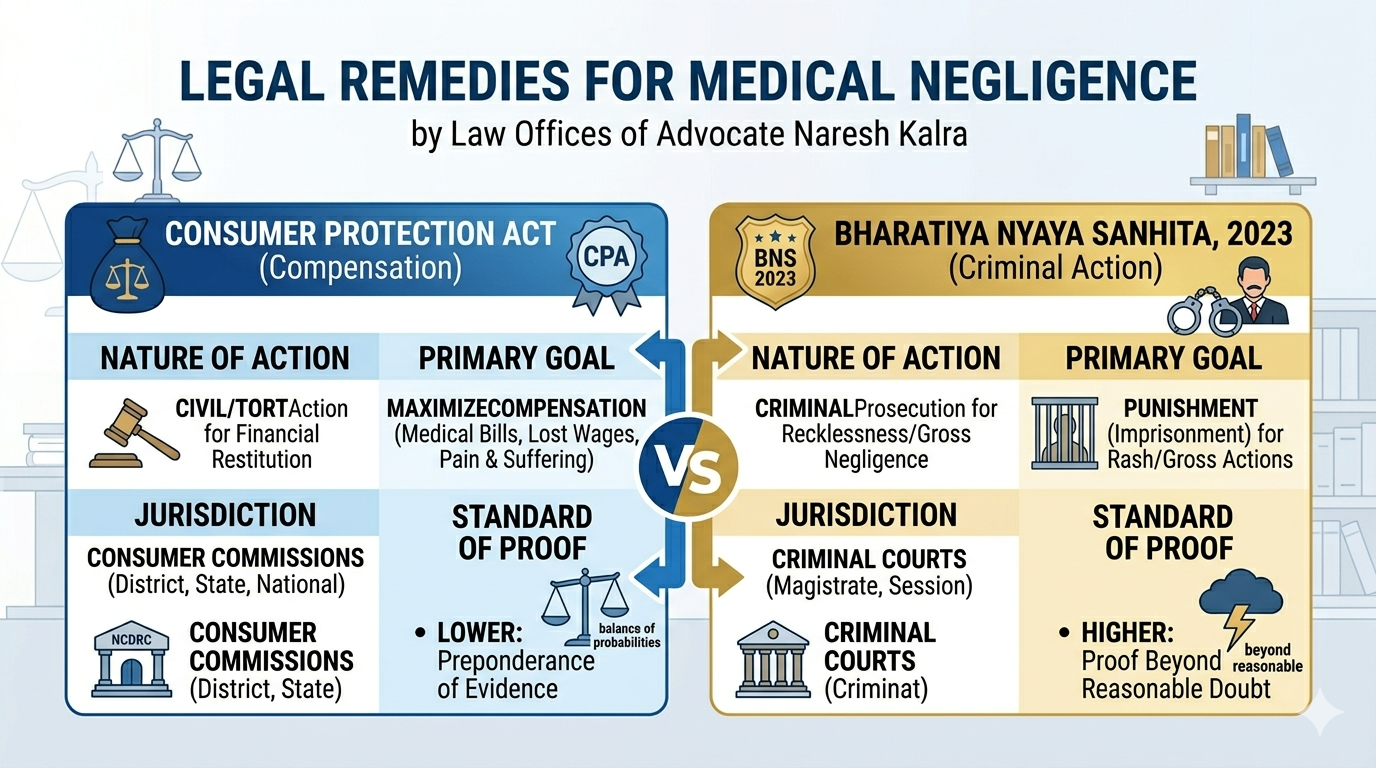
Depending on the severity of the malpractice, our firm deploys a multi-pronged legal strategy across civil, criminal, and consumer forums to ensure comprehensive relief. Navigating these overlapping frameworks is why victims look for a dedicated medical malpractice lawyer India.
This is the most effective and structured route for seeking financial recovery. Medical treatment provided for a fee is recognized as a "service" under the law. We file actions before the appropriate Consumer Disputes Redressal Commissions to claim the right hospital negligence compensation India, the same statutory route we regularly use across our broader consumer cases in India practice for deficiency-of-service disputes generally.
Under Section 69 of the Consumer Protection Act, 2019, a formal complaint must ordinarily be filed within 2 years from the date the cause of action arose. However, the Act also carries a proviso that allows the Commission to condone this delay and still admit the complaint where the complainant can show "sufficient cause" for not filing on time — for instance, where the negligence only became apparent later, or where the patient was medically incapacitated during that period. We assess this on a case-by-case basis rather than assuming a claim is time-barred simply because two years have passed.
Critical Legal Update: All previous references to the old IPC sections are obsolete. Our firm files cases under the latest criminal statutes
It is critical to understand that criminal prosecution of a doctor is held to a much higher bar than a civil or consumer claim. In Jacob Mathew v. State of Punjab, (2005) 6 SCC 1, decided on 5 August 2005 by a three-judge bench of the Supreme Court of India, the Court held that criminal liability requires proof of "gross" negligence — not the ordinary civil standard — and that no doctor should be arrested or criminally prosecuted without a prior independent expert medical opinion supporting the allegation. This protects practitioners from harassment while still allowing genuinely reckless conduct to be prosecuted.
Under the doctrine of Vicarious Liability, an employer is held liable for the negligent acts of its employees committed during the course of their employment. At the Law Office of Advocate Naresh Kalra, we ensure that both the treating consultant and the corporate hospital infrastructure are made joint parties to the suit.
Naming the hospital as a joint party alongside the individual doctor matters in practice: hospitals generally carry institutional indemnity or insurance cover and have identifiable assets, which materially improves the likelihood that an awarded compensation amount is actually recoverable, rather than remaining an uncollectable paper decree against an individual practitioner.
Negligence claims against government and public sector hospitals raise a distinct set of practical complications that a private-hospital claim does not, even though the underlying substantive law of negligence is the same.
In short: a government hospital is not immune from a medical negligence claim, but the case strategy, the parties impleaded, and the evidence-gathering process differ meaningfully from a claim against a private nursing home or corporate hospital chain.
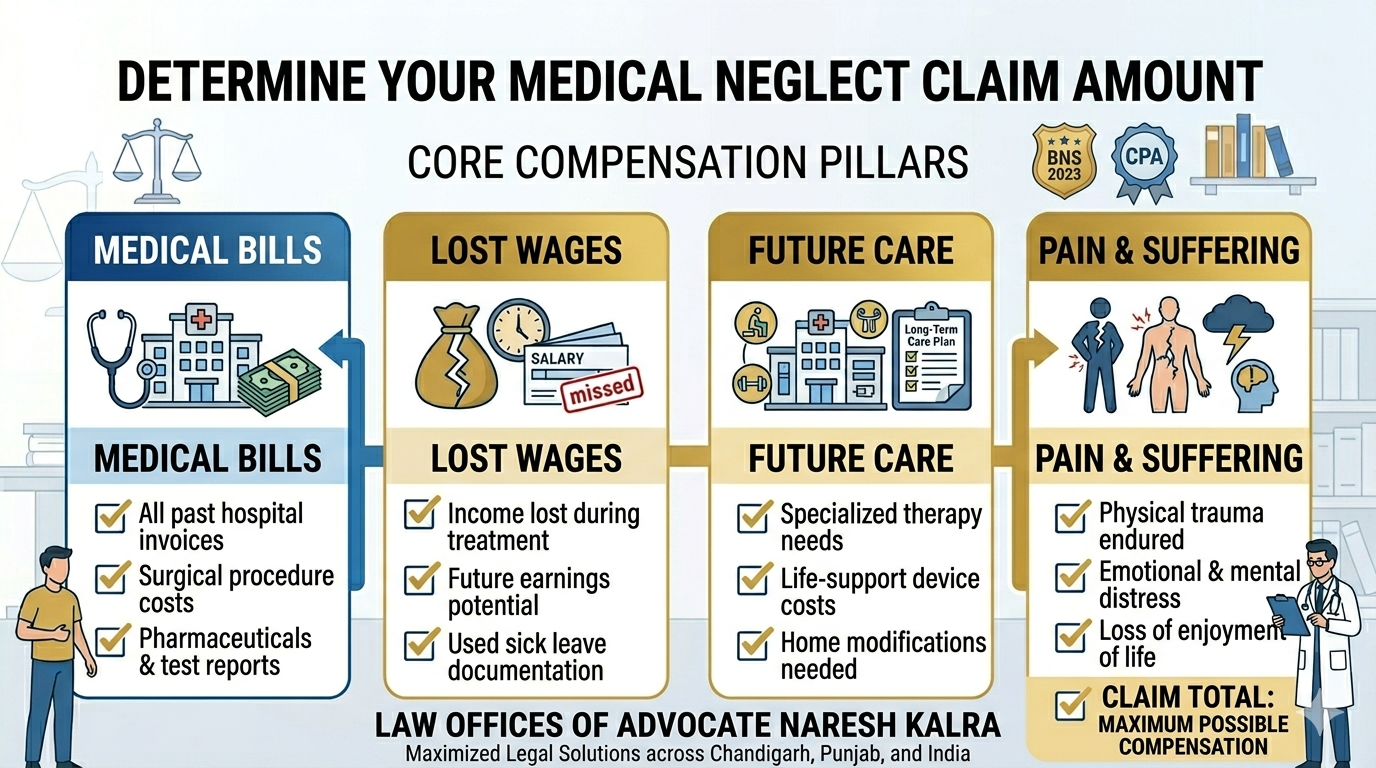
The courts in India do not use a standard formula for medical malpractice instead, they evaluate the unique facts of each case. Our strategic approach ensures that every single variable is quantified to secure a substantial medical negligence compensation claim India
| Head of Compensation | What It Covers |
|---|---|
| Actual Medical Costs | Comprehensive aggregation of all past hospital bills, pharmacy receipts, diagnostic charges, and expenses from corrective surgeries needed to treat the malpractice injuries. |
| Future Medical & Life Care Expenses | Scientific estimation of the financial support required for long-term rehabilitation, continuous medication, adaptive medical equipment, and full-time home nursing care. |
| Loss of Income & Earning Capacity | If the malpractice causes a permanent or partial disability that stops the victim from working, we calculate lifetime lost wages based on age, qualifications, and career path. |
| Pain, Suffering & Loss of Amenities | Financial valuation of the severe physical pain, emotional trauma, anxiety, and depression caused to the patient and, in fatal cases, to surviving dependents. |
| Attendant & Care-Giving Costs | Wages of trained nursing attendants or family caregivers required because of a permanent disability caused by the negligence, projected over the victim's likely lifespan. |
| Loss of Consortium / Dependency (Fatal Cases) | Compensation to the spouse, children, or dependent parents for the loss of a breadwinner's income, guidance, and companionship following a wrongful death. |
To illustrate the scale Indian courts have shown they are prepared to award in a serious, well-proven case, the Supreme Court in Dr. Balram Prasad v. Dr. Kunal Saha & Ors. (24 October 2013) — the AMRI Hospital, Kolkata case, popularly referred to as the "Kunal Saha case" — awarded compensation of approximately ₹6.08 crore plus interest, India's highest medical negligence award at the time. It remains one of the most frequently cited precedents for the outer scale of damages available under Indian law, though it is not a benchmark or a promise for what any individual claim will recover; every award still turns entirely on that claimant's own medical records, income proof, and expert evidence.
Medical negligence litigation is highly complex. Judges rely heavily on documentary evidence and expert medical test reports. When you partner with a trusted doctor negligence lawyer India at our firm, we build a solid evidence portfolio consisting of
Speed matters here. Medical records can be incomplete, altered, or difficult to obtain once a hospital anticipates litigation, so the sooner a certified copy of the complete treatment file is requested — ideally within days of the adverse outcome — the stronger the evidentiary foundation of the eventual claim.
Navigating a medical malpractice case requires a deep understanding of both advanced healthcare concepts and procedural law. Here is why clients look to us when searching for the best medical negligence lawyer India
If you believe you or a family member has suffered harm due to a misdiagnosis, surgical error, medication mistake, or hospital negligence, do not wait to have your records reviewed — book a free, confidential consultation to understand your options before any limitation period runs out.
You must establish the "Four Ds": that a doctor-patient duty of care existed, that the doctor or hospital breached that duty by falling below the standard of a reasonably competent practitioner, that this breach directly caused your injury, and that you suffered quantifiable damages. The Supreme Court's guidelines in Kusum Sharma v. Batra Hospital (2010) 3 SCC 480 are the leading test courts apply. In practice, proof requires the complete medical record and, almost always, an independent expert medical opinion confirming the deviation from accepted clinical protocol.
There is no fixed formula. Compensation is assessed case by case across heads such as actual and future medical costs, loss of income and earning capacity, attendant and care-giving costs, and pain, suffering, and loss of amenities. Indian courts have shown they are willing to award very substantial sums in proven, serious cases — the Supreme Court awarded approximately ₹6.08 crore plus interest in Dr. Balram Prasad v. Dr. Kunal Saha (2013), India's highest medical negligence award at the time — but the actual figure in any case depends entirely on the claimant's own medical records, income proof, and expert evidence.
Under Section 69 of the Consumer Protection Act, 2019, a formal complaint must ordinarily be filed within 2 years from the date on which the cause of action arose (i.e., the date the negligent treatment occurred or was discovered). The Act also allows the Commission to condone this delay where the complainant shows "sufficient cause" for not filing on time, so a claim is not automatically barred the day the two years lapse — but filing promptly remains the safest course.
Timelines vary widely depending on the forum and complexity. A straightforward District Commission consumer case with clear expert evidence may conclude in 1 to 3 years, while State or National Commission matters, or cases involving a parallel criminal complaint, can take considerably longer, particularly where the opposite party contests every procedural step or appeals an interim order. Cases with a strong, early independent expert opinion and complete medical records generally move faster than those where evidence has to be fought for through court-ordered discovery.
Yes. Where a government hospital charges even a nominal fee, or treats some patients on payment while others receive free treatment, a consumer complaint can still be filed under the Consumer Protection Act, 2019 through the same District, State, or National Commission structure used against private hospitals. Claims against government hospitals do involve additional practical steps — such as correctly impleading the relevant government department and, often, using Right to Information Act requests to obtain internal records — but a public hospital is not immune from a negligence claim.
At minimum you need the complete inpatient and outpatient records, operative notes and anesthesia logs, diagnostic films and lab reports, billing records, and any photographs or communication evidence around the time of the incident. The single most important piece of evidence is an independent expert medical opinion — a signed assessment from a qualified, unconnected medical professional confirming that the treatment fell below accepted clinical standards. Our full evidence checklist is set out in the "Blueprint of Evidence" section above.
No. As established by the Supreme Court of India in Jacob Mathew v. State of Punjab, (2005) 6 SCC 1, and further clarified in Kusum Sharma v. Batra Hospital (2010) 3 SCC 480, a doctor cannot be held liable for negligence simply because a treatment failed or a recognized risk materialized, provided they followed the standard of care a reasonably competent practitioner in that field would have followed. Negligence requires proof of an actual deviation from that standard, not just an unfavorable result.
Yes. Civil/Consumer actions for financial compensation and criminal prosecutions under Section 106 of the BNS, 2023 for reckless behavior are independent legal remedies. A victim or their family can pursue both options simultaneously by engaging a dedicated medical negligence case lawyer India. Note, however, that criminal prosecution requires proof of "gross" negligence, a higher bar than the civil standard, as held in Jacob Mathew v. State of Punjab (2005).
Vicarious liability means a hospital, as an employer, can be held legally responsible for the negligent acts of its employees — resident doctors, nurses, technicians, and administrative staff — committed in the course of their duties. Hospitals can also be held directly liable for failing to verify the credentials of empanelled or visiting consultants, or for maintaining unsafe facilities and equipment. This is why we make it a practice to implead both the treating doctor and the hospital as joint parties, since the hospital typically carries insurance cover that materially improves recovery of an awarded compensation amount.
Yes, and in most cases it is the correct strategy. Naming both the individual practitioner and the hospital as joint respondents allows the claim to proceed on both direct negligence (against the doctor) and vicarious or institutional liability (against the hospital) simultaneously, and improves the chances of the final award actually being recoverable, since hospitals typically have more identifiable assets and indemnity insurance than an individual doctor.
While it is not a strict legal precondition for filing a consumer complaint, obtaining an independent expert medical opinion before filing is, in practice, essential to a successful claim, and it is a mandatory prerequisite before any criminal complaint against a doctor can proceed, per Jacob Mathew v. State of Punjab (2005). We coordinate this expert review as one of the first steps after taking on a case.
Indian courts and consumer commissions typically consider actual medical costs already incurred, future medical and life-care expenses, loss of income and earning capacity, pain and suffering and loss of amenities, attendant and care-giving costs, and, in fatal cases, loss of dependency or consortium for surviving family members. Each head is quantified separately using medical bills, income proof, disability assessments, and expert testimony, and the totals are added to arrive at the final claim amount, as summarized in the compensation table above.
Yes. Contact Mr. Harish Tiwari from the Naresh Kalra Legal Team at +91-9815580037 to discuss your case and schedule your initial Free consultation.
Do not let hospital mismanagement or clinical carelessness dictate your family's future. Connect with a premier medical negligence lawyer India today.
Contact the Law Office of Advocate Naresh Kalra for a detailed, highly confidential consultation. Our legal team is ready to step in, protect your rights, and ensure your case is presented with absolute precision. Book a consultation to get started.