Nidhi Company Registration in India – A Comprehensive Guide
Nidhi Companies, functioning under the provisions of the Companies Act, 2013 and the Nidhi Rules, 2014, play a vital role in
encouraging savings and mutual benefit among their members. These entities are subject to a detailed compliance framework that
governs their establishment, operations, and financial conduct. A Nidhi Company must reach a minimum of 200 members within its
first year and maintain at least three directors at all times. Moreover, strict adherence to financial reporting norms, statutory
audits, and MCA filing obligations is essential to operate within legal bounds. Such companies are
allowed to accept deposits only from members and are limited to a deposit threshold not exceeding 20 times their Net Owned Funds (NOF).
Contents
Overview
Nidhi Companies fall under a specific category defined in Section 406 of the Companies Act, 2013. Their primary
function is to promote a culture of savings among members by facilitating deposits and loans for mutual advantage.
These entities are structured as public limited companies and are obligated to follow comprehensive legal and compliance standards.
This article explores all the regulatory touchpoints that a Nidhi Company must meet to function lawfully in India.
What is a Nidhi Company?
Nidhi Companies operate much like member-based savings groups. Formed as public companies, they must begin with at least
seven shareholders and three directors.
Their core purpose is to encourage savings and offer loans exclusively to their members for purposes like housing, education, or business.
They are governed by:
- The Companies Act, 2013
- The Nidhi Rules, 2014
- MCA-issued Circulars and Notifications
Strict operational limitations and regulatory oversight ensure
that these companies remain focused on member welfare and do not engage in unrestricted public financial activities.
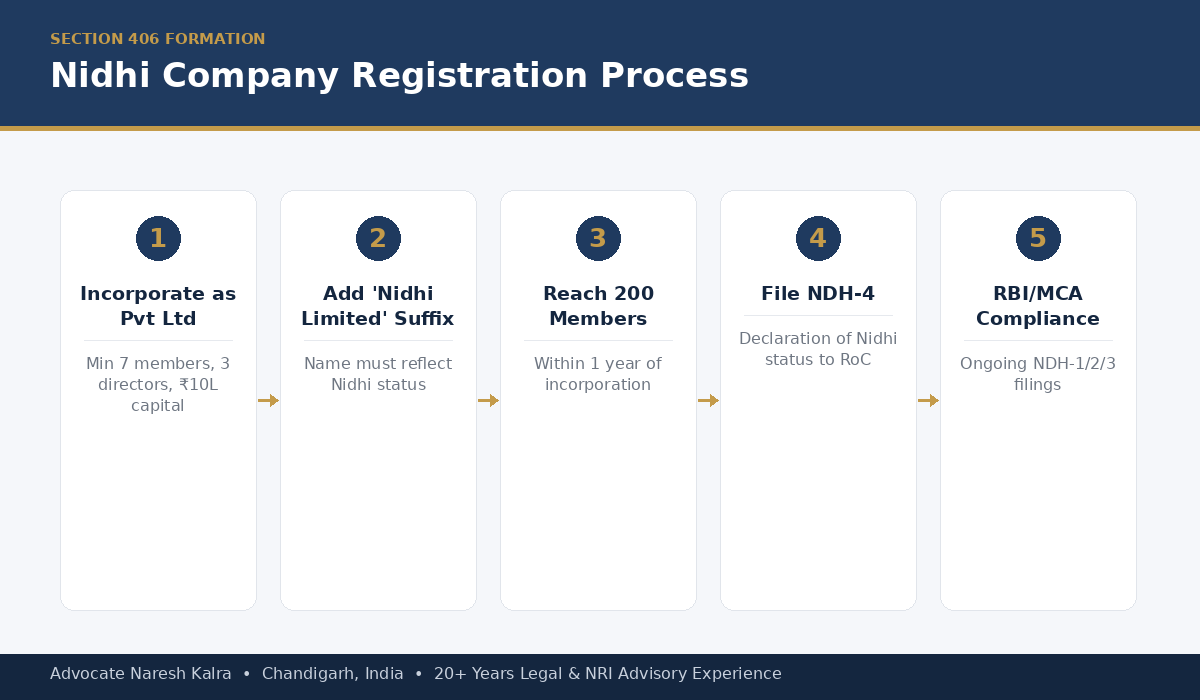
Registration Process
To start a Nidhi Company, certain minimum conditions must be met:
- At least 7 members and 3 directors
- An appropriate company name including “Nidhi”
- Registered office address
After fulfilling these prerequisites, the entity is incorporated and receives a
Certificate of Incorporation from the Registrar of Companies (RoC). Operations may
commence only after incorporation is officially completed.
Essential Compliances
Nidhi Companies must follow specific compliance rules once incorporated. Below are the primary obligations:
4.1 Member and Director Requirements
- Members: At least 200 members are mandatory within one year.
- Directors: A minimum of three directors must be maintained at all times.
Failure to meet these requirements may attract regulatory scrutiny or penalties.
4.2 Deposit Guidelines
- Deposits can be accepted only from members.
- Total deposits should not exceed 20 times the latest audited NOF.
- Interest rates and related rules must conform to the Nidhi Rules and RBI guidance.
4.3 Financial Statements and Annual Returns
Companies must prepare:
- Balance Sheet
- Profit & Loss Statement
- Cash Flow Statement (if applicable)
- Statutory Audit Report
Annual filings with the Ministry of Corporate Affairs include:?
- Form AOC-4 (financial statements)
- Form MGT-7 (annual return)
These forms must be submitted within 30 days of the AGM.?
4.4 Statutory Audit
An annual statutory audit is compulsory, conducted by a qualified Chartered Accountant.
The audit ensures accuracy in financial records and compliance with financial regulations.
4.5 Bookkeeping Requirements
Companies must maintain:
- Cash Book
- General Ledger
- Journal
- Register of Members
These records should be current and available for inspection when required.
4.6 Deposit Management
Nidhi Companies must:
- Maintain separate accounts for member deposits
- Ensure funds are used only for member-related activities
- Avoid unsecured loans and restricted investments
Non-compliance can result in suspension or penalties.
4.7 Regulatory Filings
Companies must submit various forms to MCA:
- DIR-12 for director appointments/changes
- MGT-14 for board resolutions
- SH-7 for changes in share capital
Missing deadlines can lead to fines or legal action.
4.8 Reporting to RBI (if Applicable)
If a Nidhi Company engages in activities overlapping with banking, RBI may require:
- Quarterly or annual filings
- Adherence to specific RBI directives
Regulatory Safeguards
Key regulatory checkpoints include:
- Minimum NOF: ₹10 lakhs required at incorporation
- Dividend Cap: Not more than 25% of paid-up capital
- Audit Vigilance: Auditors must report discrepancies to regulators promptly
These measures are designed to preserve financial transparency and protect member interests.
Consequences of Non-Compliance
Violations can result in:
- Financial Penalties: Ranging from ₹1 lakh to ₹5 lakhs
- Deregistration: The RoC can strike off persistent defaulters
Remaining compliant is vital to maintaining a good standing.
Final Thoughts
Nidhi Companies serve a unique and important role in India’s financial inclusion landscape. By encouraging responsible
saving and lending within a closed member group, they create a self-reliant
financial ecosystem. However, to operate smoothly and legally, it is critical that they follow all regulatory procedures meticulously.
Why Partner with Us?
The firm offers specialized support tailored to Nidhi Company needs:
- Complete Compliance Coverage: From setup to daily compliance, the firm manages it all.
- Legal & Financial Expertise: Our professionals offer end-to-end support on Companies Act, 2013 and Nidhi Rules, 2014 matters.
- Timely Documentation: We ensure that filings with MCA and other bodies are submitted promptly.
- Transparent Audits: Our CA partners conduct audits that reflect your business accurately.
- Avoid Penalties: Stay worry-free with our proactive compliance tracking system.
- Customized Service: Solutions aligned with your company’s specific operational style and structure.
Related Services Offered by Our Firm
The firm isn’t just your partner for Nidhi Company compliance—we also support:
- NGO and Microfinance Company Registration
- Trademark and IP Protection
- GST Registration and Filings
- Company Formation and Tax Advisory
- ROC and MCA Compliance
Our efficient processes, cost-effective solutions, and domain
expertise make us the go-to choice for businesses seeking legal clarity and regulatory assurance.