Political Party Registration in India: Procedure, Significance & Legal Insights
Registering a political party is a foundational step for any group aspiring to take part in the democratic process.
It grants legal status, enables participation in elections, and opens the door for state funding and representation.
In this guide, we unpack the essentials of political party registration—its necessity,
procedural framework, legal requirements, and how a platform like the firm can support you throughout the process.
Contents
Introduction
In any vibrant democracy, political parties serve as crucial instruments of representation. They amplify public concerns,
shape governance policies, and organize electoral participation. However, to participate officially in the electoral arena,
a political party must undergo a formal registration process with the designated electoral authority. This legal step not
only confers legitimacy but also allows the party to contest elections, raise funds lawfully, and communicate its ideology
to the masses.
This article provides a complete overview of the political party registration process in India and other major democracies,
the reasons it is essential, and how legal experts can simplify the process.
What Is Political Party Registration?
Political party registration is the formal mechanism by which a political group gains legal recognition from the country's
election commission. This recognition is essential for contesting elections, promoting policies, and accessing electoral
benefits such as reserved symbols and funding.
To become a registered political party, an organization typically needs to submit foundational documents like a party
constitution, list of office bearers, member data, and financial disclosures, depending on the legal requirements of the
country.
Key Reasons to Register a Political Party
Legal Recognition and Status
Registration officially designates the group as a political party, allowing it to function within the legal and democratic
framework of the country.
Election Eligibility
Only registered parties can nominate candidates to contest local, state, or national elections. Registration is a
prerequisite to appearing on ballots and campaigning under a common symbol.
Access to Resources and Benefits
Registered parties may qualify for public funding, free airtime on state-run media, and subsidized election materials.
These advantages help level the playing field for new and emerging parties.
Structured Political Expression
Registration facilitates policy development, outreach, and organized campaigning. It enables the party to legally conduct
rallies, debates, and membership drives.
Legal Safeguards
Once registered, a party enjoys protections under national laws, such as freedom of association and the right to operate
politically without undue interference—provided it complies with all regulatory requirements.
Legal Provisions Governing Registration
General Legal Requirements
While the specifics may differ across countries, the following components are generally mandatory:
- Party Constitution: A detailed document outlining party principles, governance structure, leadership selection, and disciplinary procedures.
- Leadership Details: A list of office bearers with defined roles (e.g., president, secretary, treasurer).
- Membership Base: A minimum number of active members, often backed by signatures or identity proofs, is required to establish public support.
- Proof of Support: Some jurisdictions mandate that parties submit affidavits or petitions showing grassroots-level endorsement.
- Electoral Authority Affiliation: Parties must register with national or state-level election bodies and agree to abide by electoral codes.
- Financial Disclosures: Transparency regarding funding sources and expenditure is mandatory to avoid malpractice and promote trust.
Country-Specific Examples
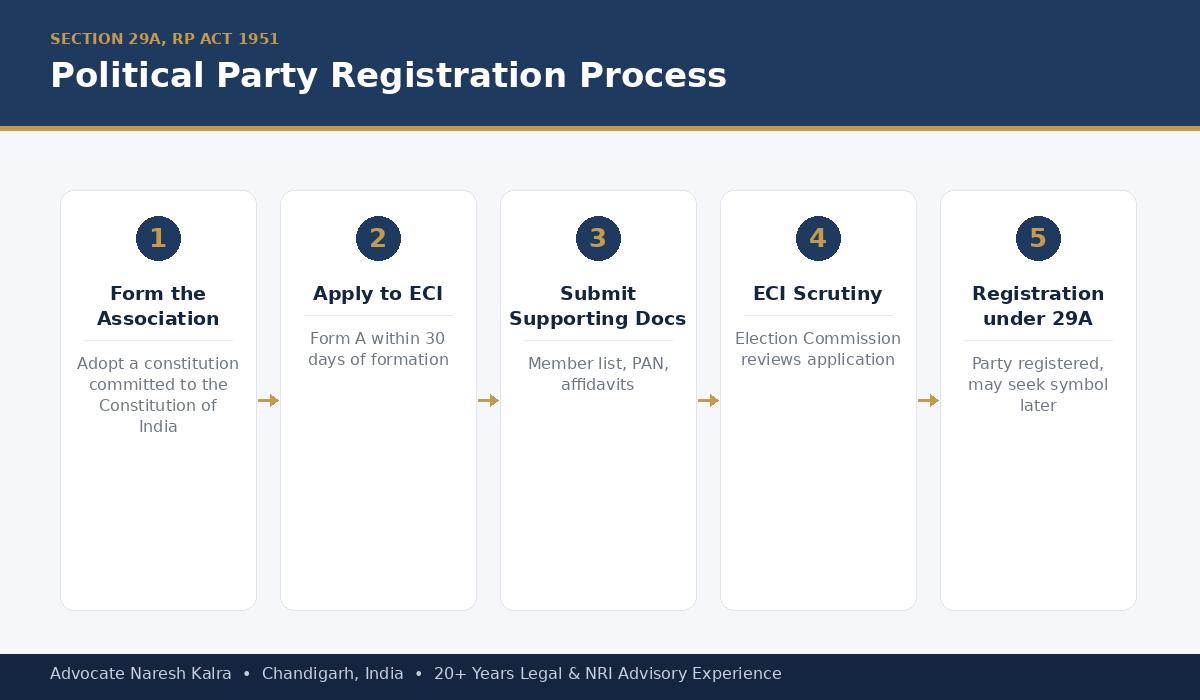
- India: The Election Commission of India (ECI) oversees party registration. Applicants must submit Form 1, a copy of
the constitution, leadership details, and proof of organizational presence across multiple states.
- United States: Political parties register at the state level. Ballot access often depends on gathering a set number
of voter signatures per state.
- United Kingdom: The UK Electoral Commission mandates a party name, emblem, constitution, and leader's identity.
Parties must follow political finance rules under the Political Parties, Elections and Referendums Act.
- Canada: Elections Canada governs registration. A party must provide a constitution, leader’s endorsement, and proof
of 250 members.
Step-by-Step Guide to Registering a Political Party
Step 1: Draft a Constitution
Begin by preparing a well-structured constitution detailing party ideology, governance, membership process, and election
procedures within the party.
Step 2: Establish Leadership
Form an official leadership team, typically comprising a president, general secretary, and treasurer. Roles and
responsibilities should be clearly defined.
Step 3: Recruit Core Members
Gather a minimum number of committed members. Their details—names, voter IDs, and signatures—may be needed as proof
of public support.
Step 4: File Application with Electoral Body
Submit a formal application along with supporting documents (constitution, leadership list, member records) to the
electoral commission.
Step 5: Demonstrate Public Support
Fulfill requirements to prove grassroots support. This can include signatures of registered voters or affidavits
supporting the party’s agenda.
Step 6: Submit Financial Information
Disclose funding sources and bank details. Ensure all contributions and expenditures are recorded and compliant with
campaign finance rules.
Step 7: Get Official Approval
Once the application and supporting documents are verified, the party receives a certificate of registration, granting
it legal and electoral status.
Conclusion
Political party registration is not just a legal necessity—it's a strategic step toward influencing governance,
representing public issues, and gaining electoral legitimacy. Whether for emerging movements or organized political
coalitions, registration facilitates participation in the democratic ecosystem while ensuring compliance with national
laws.
With political activity subject to increasing scrutiny and regulation, understanding the procedural nuances of party
registration is crucial for long-term success.
Why We Are the Right Partner for Political Party Registration
In-Depth Legal Knowledge
The firm’s experienced legal team ensures complete adherence to all procedural and documentary requirements,
minimizing errors and delays.
Full-Service Assistance
From drafting the constitution to preparing membership records and filing with the electoral body, the firm
manages the entire process end to end.
Transparent Compliance Management
Their specialists provide guidance on financial disclosures and campaign fund management to ensure full
compliance with electoral finance laws.
Fast Turnaround
With a deep understanding of procedural timelines, the firm ensures that your registration is completed
efficiently, so you can begin organizing and campaigning.
Customized Legal Support
Every political organization is unique. The firm offers tailored legal solutions based on your party’s
vision, size, and strategic goals.
Multi-Jurisdictional Expertise
Whether you’re registering at the national or regional level, the firm understands the specific nuances
across different electoral jurisdictions.
Affordable Plans
The firm offers competitive pricing without compromising service quality, making political party
registration accessible to all aspiring parties.
Ongoing Legal Support
Beyond registration, the firm also assists with legal compliance, internal governance, dispute
resolution, and strategic documentation.
Other Services Offered by Our Firm
- Microfinance & NBFC Registration: Specialized services for setting up microfinance and NBFC entities under RBI regulations.
- Trademark & IP Protection: Trademark, copyright, and patent registration to secure your brand identity.
- Contract & Agreement Drafting: Professionally crafted legal documents for business and organizational use.
- GST Filings & Tax Advisory: End-to-end support for GST registration, returns, and corporate tax compliance.
- Corporate Restructuring & M&A: Assistance with mergers, acquisitions, and business transformations.
- Labor Law Compliance & Licensing: Help with HR policies, statutory compliance, and obtaining government permits.
- Accounting & Financial Reporting: Bookkeeping and financial compliance for transparency and growth.
- Litigation & Legal Dispute Resolution: Effective representation in courts or arbitration for conflict resolution.
- OPC & Private Limited Company Registration: Assistance for solo founders and business groups to formalize their operations legally.