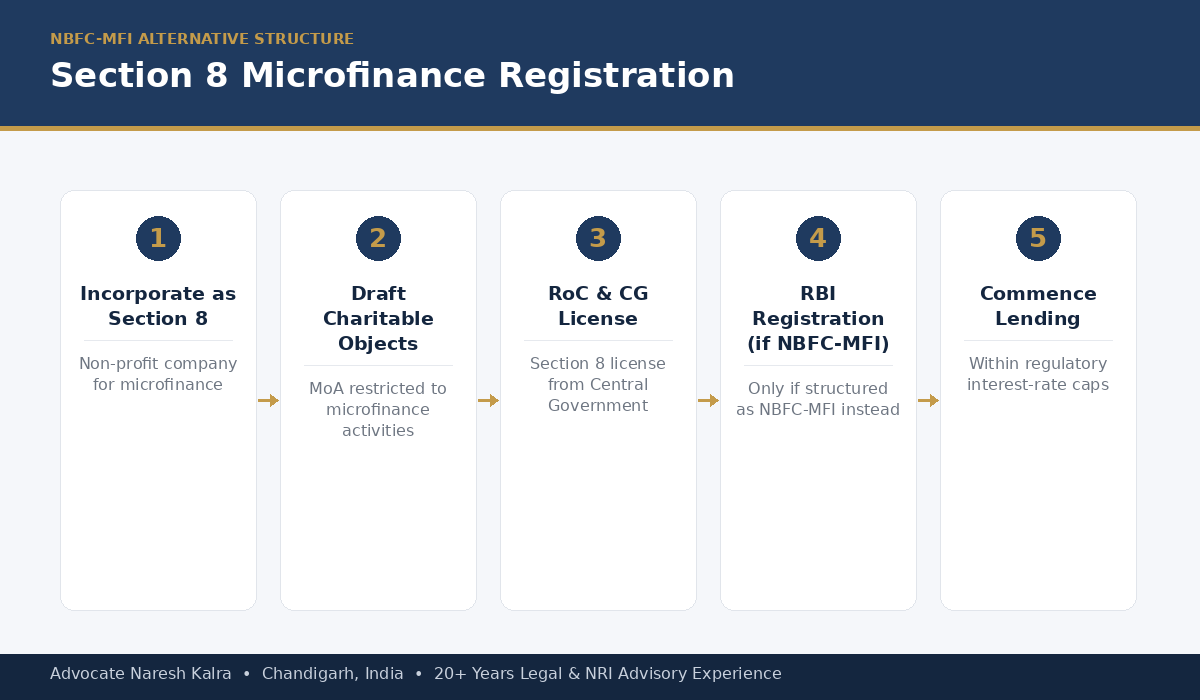
Section 8 Microfinance Company Formation in India – Procedure & Costs
Starting a finance venture in India without RBI approval or capital barriers? Registering as a Section 8 Microfinance
Company is your most efficient route. These entities are formed to serve low-income groups and help alleviate poverty
through micro-lending, without the regulatory burden that typical financial institutions face.
Overview of Section 8 Microfinance Company Setup
A Section 8 Microfinance Company offers a unique opportunity to initiate a financial services business aimed at social
upliftment, all without the usual RBI licensing hurdles or capital restrictions. Recognized under the Companies Act, 2013,
and operating within the exemptions laid out in RBI's Master Circular (RBI/2015-16/15 DNBR (PD) CC.No.052/03.10.119/2015-16
dated July 1, 2015), these entities can legally issue unsecured loans to eligible borrowers.
They can offer small-ticket personal loans, group-based credit, or household funding at interest rates capped at 26% per
annum, adhering to RBI's microfinance norms. Understanding the step-by-step formation process is key to getting started.
Contents:
Why Choose a Section 8 Microfinance Company?
Registering as a Section 8 Microfinance Company offers several strategic benefits:
- Non-Profit Status: Surpluses are redirected toward the company’s social mission.
- Tax Exemptions: Profits reinvested into welfare initiatives may qualify for tax relief.
- Ease of Compliance: Compared to NBFCs, regulatory requirements are lighter.
- RBI License Not Mandatory (Under Rs. 100 Cr): Until your asset base exceeds ₹100 crore, there's no need to get an NBFC license.
- Regulatory Alignment: Still operates within RBI's lending norms for microfinance.
- No Capital Threshold: Freedom to begin operations without a mandated minimum capital.
How to Get Your Section 8 Microfinance Company Registered?
To initiate your application, you must approach the Ministry of Corporate Affairs (MCA). Once
registered, there's no need to seek RBI permission unless you cross the threshold mentioned under RBI norms.
Step-by-Step Registration Process
- Get DSC & DIN: Each director needs a valid Digital Signature Certificate (DSC) and Director Identification Number (DIN).
- Name Reservation (INC-1): Propose a name that reflects microfinance as your primary activity.
- Draft MoA and AoA: These define your mission and operational scope.
- File for Incorporation (INC-32): Submit all details and documents digitally via MCA’s portal.
- Apply for PAN & TAN: Essential for tax registration.
- Open a Corporate Bank Account: Recommended to work with banks familiar with Section 8 norms.
Required Documentation
To complete registration:
- Director KYC Documents: Aadhaar, PAN, and address proof for at least two directors.
- Office Address Proof: Electricity bill/rent agreement + NOC from the owner.
- Company Objective: Clearly describe your microfinance mission in the MoA.
- Shareholding Information: Include percentages for all initial members.
- Capital Plan: Indicate authorized and paid-up capital per your operational scope.
Loan Eligibility & Household Income Limits
Microfinance loans under Section 8 are tailored for low-income households. Here's how lending limits are determined:
- Only families earning up to ₹3 lakh annually qualify.
- Repayment capacity is a must — EMIs cannot exceed 50% of the household’s monthly income.
- If a family earns ₹20,000/month (₹2.4 lakh/year), their maximum EMI must be capped at ₹10,000.
- Existing obligations over 50% EMI threshold disqualify a family from new loans.
- Household Definition: A nuclear family unit (couple + unmarried children).
Board Policy: If your company wants to lend below this 50% EMI threshold, it must adopt a formal policy approved by its board.
Reporting & Data Compliance: You must routinely share borrower data with Credit Information Companies (CICs) to ensure borrowers do not exceed debt limits.
Core Features of Section 8 Microfinance Companies
- ROC-Registered Non-Profit: Operates under the Companies Act as a non-profit.
- Exempt from RBI Licensing: No need for an NBFC license under ₹100 Cr.
- High Lending Flexibility: Can charge up to 26% p.a. interest.
- Legal Enforcement Rights: May initiate legal action against defaulters.
- Statutory Compliance: Must file annual returns and financials with MCA.
- Socially Aligned Activities: Can also take up health, education, and sanitation initiatives.
- Pan-India Reach: No territorial restrictions on operations.
- No Minimum Capital: Start without a prescribed capital limit.
- Unsecured Loans: Loans can be offered without collateral.
Registration Costs
The entire process costs around ₹1,20,000. This includes government charges, documentation, and professional fees.
Beware of offers that seem too inexpensive—they may come with hidden issues or non-compliant procedures.
MCA’s Circular & Impact on Registrations
Despite concerns raised by a specific MCA notification on the registration of finance-related companies, Section 8
Microfinance Companies can still be legally incorporated. Expert guidance can help you steer through any confusion
and complete registration smoothly.
Activity Codes Explained
Companies in India are assigned a specific activity code based on their business domain:
- Code 64: Financial services category.
- Code 88: Social or community services.
You can register your company under Code 88 for social lending or under Code 64 if you want to make your financial intent immediately identifiable.
Credit Bureau Memberships (CIBIL & Alternatives)
There are four major credit bureaus in India:
- CIBIL (TransUnion)
- CRIF High Mark
- Equifax
- Experian
While TransUnion CIBIL may restrict access to Section 8 entities lacking an NBFC
license, the other three bureaus are more accessible and regularly offer membership for credit history tracking.
Are Donations Allowed?
Yes, Section 8 Companies can legally accept donations. However, using donated funds for interest-bearing loans
may contradict the social-purpose requirement. Donations are best used for non-revenue-generating community programs.
Auto-Debit for EMI Collections
Yes, you can apply for an auto-debit facility with your bank to simplify EMI collections. This helps reduce
operational effort and ensures timely repayments.
Loan Processing Charges
Section 8 Microfinance Companies can charge a processing fee, typically capped at 1% of
the loan amount. This covers administrative and disbursal costs. Borrowers should be informed of all fees transparently.
Final Thoughts
Forming a Section 8 Microfinance Company is an excellent way to legally engage in social financing across India without
bearing the cost or burden of an RBI license. With a focus on underserved populations and low-income families, this
structure supports poverty alleviation and financial inclusion. If you're looking to create meaningful change through
finance, start your journey by registering today.
Let me know if you’d like this turned into a downloadable brochure, blog post format, or want to add internal links or
CTAs for the firm or other Regulatory and Compliance Issues.