Get trusted legal guidance from experienced advocates. We provide strategic legal advice, strong representation, transparent communication, and practical solutions tailored to your case with a focus on fast, effective results.
A sudden vehicular collision changes everything in a fraction of a second. Beyond the immediate physical trauma and emergency hospitalization, victims and their families are abruptly forced to deal with catastrophic financial stress, permanent loss of earning capacity, and endless battles with aggressive insurance companies. The legal framework in India provides a dedicated pathway for justice through the Motor Accident Claims Tribunal (MACT), but navigating this domain requires specialized, aggressive legal advocacy.
At the Law Offices of Advocate Naresh Kalra, a premier motor accident law firm India, we believe that financial restitution is a fundamental right for every innocent road accident victim. As an established motor accident claim lawyer India, we represent individuals and families across Chandigarh, Mohali, Panchkula, Ludhiana, Punjab, Haryana, and pan-India, helping them secure their rightful legal dues.
Whether you are dealing with minor fractures, severe catastrophic disabilities, or the wrongful death of a primary breadwinner, our comprehensive motor accident compensation lawyer India services ensure that you do not have to fight powerful insurance corporations alone. Motor accident claims are, at their legal core, a specialized branch of the wider law of tort and personal injury claims in India — the same principles of negligence, duty of care, and compensable harm apply, only channeled through the dedicated MACT forum. If you are searching for the best motor accident lawyer India, our legacy of data-driven, strategic legal execution stands ready to protect your family's future.
How much compensation can I get? There is no fixed "average" payout — Indian tribunals calculate compensation using the multiplier method laid down by the Supreme Court in Sarla Verma v. Delhi Transport Corporation (2009) and refined in National Insurance Co. Ltd. v. Pranay Sethi (2017). The final figure depends on the victim's age, monthly income, the percentage of permanent disability (in injury cases) or number of dependents (in death cases), a statutorily-linked age-based multiplier, and a "future prospects" addition of 40%, 25%, or 10% of income depending on the victim's age at the time of the accident. A specialized motor accident lawyer in Chandigarh, Mohali, Panchkula, or Ludhiana can work out a realistic range for your specific facts before you accept any insurance company offer.
How long does it take? Straightforward claims with clear liability and complete documentation can often conclude within roughly 1 to 2 years; multi-vehicle pile-ups, fatal accident cases, or contested-liability matters can take 3 to 5 years or longer, particularly if the award is appealed to the Punjab & Haryana High Court. Where applicable, interim or no-fault compensation can frequently be secured much earlier in the process — well before the tribunal delivers its final award.
The Motor Vehicles Act, 1988 (deeply amended to enforce stricter compliance and higher accountability) forms the backbone of all road mishap litigations in India. The law mandates that specific tribunals — known as Motor Accident Claims Tribunals — handle all cases involving third-party property damage, bodily injury, or fatalities caused by vehicular accidents.
When you engage an expert MACT lawyer India, our priority is to evaluate the legal framework governing your specific incident. The law broadens liability under two primary categories
This is the most common path pursued by an accident claim lawyer India. Under this provision, the claimant files a petition proving that the accident occurred due to the explicit rashness, negligence, or mechanical non-compliance of the offending vehicle's driver. This route requires a detailed presentation of evidence but opens the doors to unlimited, fully maximized compensation based on the victim's actual financial loss and age, computed through the standardized multiplier method explained below.
The statutory framework also protects victims where proving absolute negligence is complex or time-consuming. Under Section 164 of the Motor Vehicles Act, 1988 (as amended), the claimant or legal heirs can seek fixed, structured compensation without having to establish whose fault the collision was — currently set at Rs. 5,00,000 for death and Rs. 2,50,000 for permanent disability arising from a road accident. This no-fault amount is not an extra windfall on top of a fault-based award — it is granted on account, and is adjusted against the final compensation determined under a full Section 166 fault-liability proceeding, if one is also pursued. In practical terms, it functions as fast, guaranteed interim relief while the larger claim is litigated. A seasoned road accident claim advocate India will strategically choose the right filing track, or run both in tandem, to accelerate your recovery window.
When a MACT tribunal award is inadequate or legally challenged by the insurance company, our team of expert motor accident lawyer India professionals escalates the matter to the Punjab & Haryana High Court at Chandigarh. Appeals can run both ways — claimants seek enhancement of an inadequate award, while insurers routinely appeal awards they consider excessive, so a claimant needs equally strong representation at this stage, not just at the tribunal. Clients across Mohali, Panchkula, Ludhiana, and the entire Punjab-Haryana belt benefit from our seamless tribunal-to-High Court representation, ensuring that a low award from any local MACT bench does not become your final financial fate.
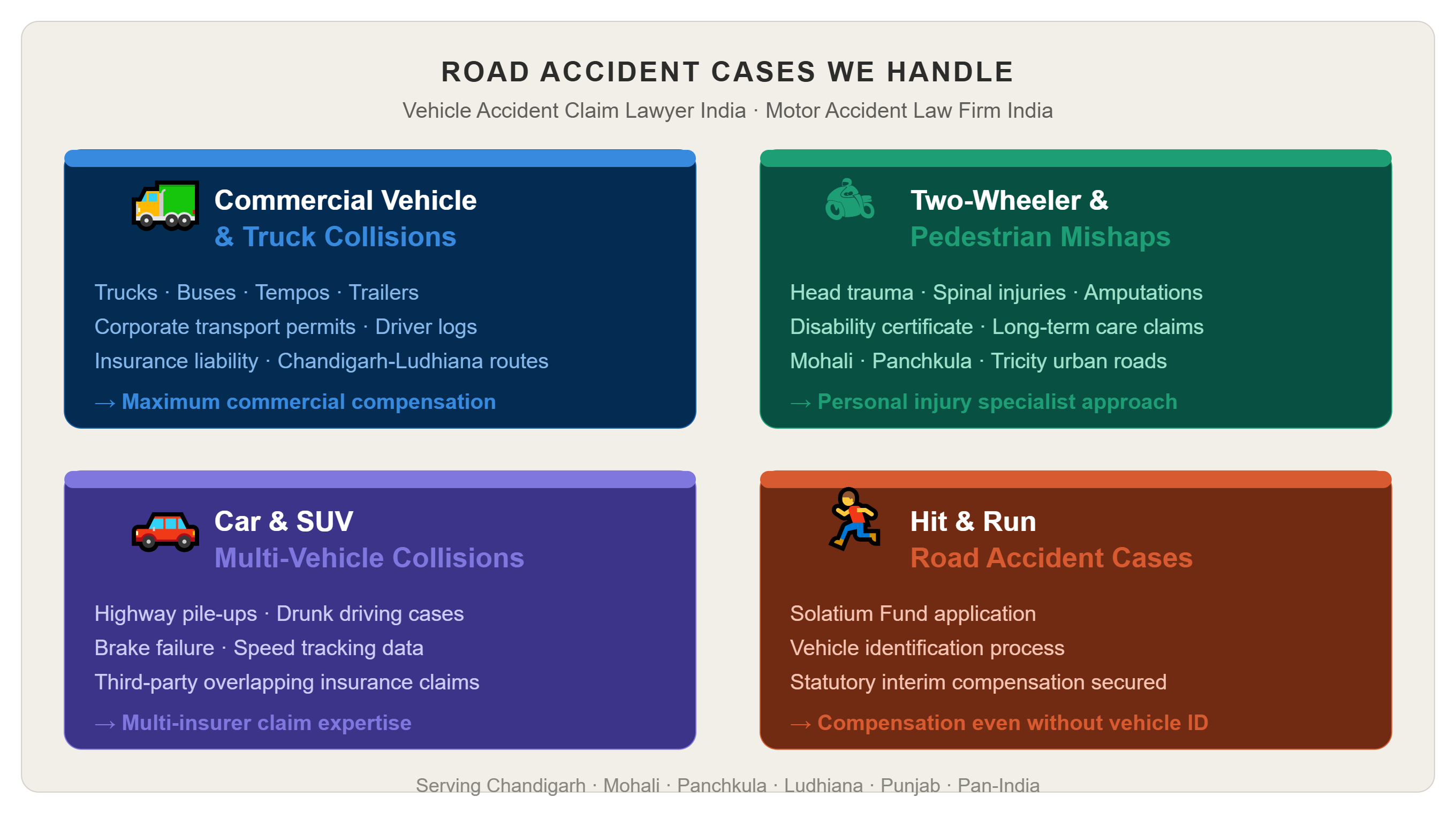
Every road accident case involves a distinct set of factual and mechanical dynamics. As an experienced vehicle accident claim lawyer India, our firm conducts comprehensive forensic, mechanical, and medical investigations into various types of mishaps
Accidents involving multi-axle trucks, public transport buses, commercial delivery tempos, and corporate trailers often result in catastrophic impact damages. Our legal team aggressively tracks down commercial transport permits, driver fitness logs, and corporate insurance liabilities to pin down corporate accountability. These cases frequently arise on the Chandigarh-Ludhiana highway belt and require a motor accident claim lawyer India with deep knowledge of transport regulations.
Motorcyclists, scooter riders, and pedestrians are the most vulnerable entities on Indian roads — frequently suffering severe head trauma, spinal cord fractures, or permanent limb amputations. Our specialized personal injury lawyer India protocols ensure that the long-term biological impact of these lifestyle-altering injuries is thoroughly mapped out before the tribunal judges, drawing on the same evidentiary standards used in broader personal injury and tort claims. We serve clients from Mohali, Panchkula, and across the Tricity region who are most commonly involved in such urban road mishaps.
Modern highway pile-ups require a sophisticated understanding of mechanical failures, highway speed tracking, and third-party insurance overlapping parameters. We dissect driver behavioral patterns, drunk-driving medical records, and brake-failure claims to safeguard our client's financial interests.
India's Motor Vehicles Act provides specific relief even where the offending vehicle flees the scene and is never identified or is uninsured. Under the Compensation to Victims of Hit and Run Motor Accidents Scheme, 2022 (framed under Section 161 of the Act, and administered through the General Insurance Council), the government-backed fund currently pays Rs. 2,00,000 to the legal heirs in a fatal hit-and-run case, and Rs. 50,000 for grievous injury. Our road accident compensation lawyer India team immediately initiates this prescribed statutory process to secure prompt relief, and simultaneously pursues any further avenue available if the vehicle or driver is subsequently traced.
Insurance companies frequently repudiate genuine claims on technical grounds — an alleged licence defect, a lapsed permit, or a disputed policy clause — or simply delay settlement to pressure a distressed family into accepting far less than the claim is worth. Where an insurer's conduct crosses from a legitimate legal dispute into unfair, deficient, or bad-faith practice, policyholders may also have independent recourse under Indian consumer protection law; our firm's consumer cases in India practice regularly handles deficiency-of-service disputes against insurers alongside the MACT claim itself, giving clients a second, parallel avenue of pressure.
A common error made by unrepresented victims is settling for a nominal, low-ball amount offered by insurance claims adjusters. At our motor accident law firm India, we calculate your claim utilizing the precise formulas accepted by the Supreme Court of India — including landmark judgments such as Sarla Verma v. Delhi Transport Corporation, (2009) 6 SCC 121 and National Insurance Co. Ltd. v. Pranay Sethi (2017) — to ensure every head of damages is fully claimed.
In Sarla Verma, decided on 15 April 2009, the Supreme Court laid down a standardized, age-based "multiplier" — a fixed number, typically ranging from around 5 for the very young or elderly up to 18 for victims in their mid-20s to 30s — that is applied to the victim's net annual income to arrive at the total loss of dependency or loss of future earnings, replacing the earlier inconsistent, case-by-case guesswork that different tribunals were applying. In Pranay Sethi, decided by a five-judge Constitution Bench on 31 October 2017, the Court went a step further and standardized the "future prospects" addition to income that must be built into every multiplier calculation — an addition of 40% of income where the victim was below 40 years of age, 25% where the victim was between 40 and 50 years, and 10% where the victim was between 50 and 60 years, applied uniformly regardless of whether the victim was in permanent, temporary, or self-employed work. Pranay Sethi also standardized the conventional, non-pecuniary heads of compensation described below so that they are no longer left to inconsistent, arbitrary tribunal discretion.
| Head of Damage | What It Covers |
|---|---|
| Loss of Actual Earnings | Total loss of income during the intensive medical treatment and rehabilitation phases, computed from documented salary or business income. |
| Loss of Future Earning Capacity | If a permanent disability stops the victim from performing their regular professional job, the multiplier method (age-linked multiplier x annual income, plus the applicable future-prospects addition) is applied to calculate lifetime income loss. |
| Actual Medical Expenses | Complete financial documentation of all past hospital admissions, surgical invoices, implant costs, pharmacy sheets, and reasonably projected future medical care and rehabilitation costs. |
| Attendant / Caregiver Charges | Many permanently disabled victims require paid, full-time home attendants; our team ensures this long-term financial burden is comprehensively factored into your final claim. |
| Loss of Marriage Prospects / Educational Loss | In cases involving young, unmarried, or student victims with disfigurement or severe disability, tribunals additionally recognize the diminished life and marriage prospects flowing from the injury. |
| Head of Damage | What It Covers |
|---|---|
| Pain and Suffering | The immense physical trauma and mental shock endured by the victim during and after the impact, and through subsequent treatment. |
| Loss of Consortium | Legal compensation granted to a surviving spouse, children, or parents for the loss of companionship, affection, and parental or filial guidance in fatal cases — a head standardized in Pranay Sethi. |
| Loss of Amenities of Life | Compensation for the permanent inability to enjoy a normal lifestyle, sports, hobbies, or social activities as a result of the disability. |
| Loss of Estate | A conventional, fixed non-pecuniary sum recognized in fatal cases to compensate the estate of the deceased, standardized alongside the other conventional heads. |
| Funeral and Last Rites Expenses | In fatal accidents, documented funeral costs are compensable as a standardized conventional head under the established legal framework. |
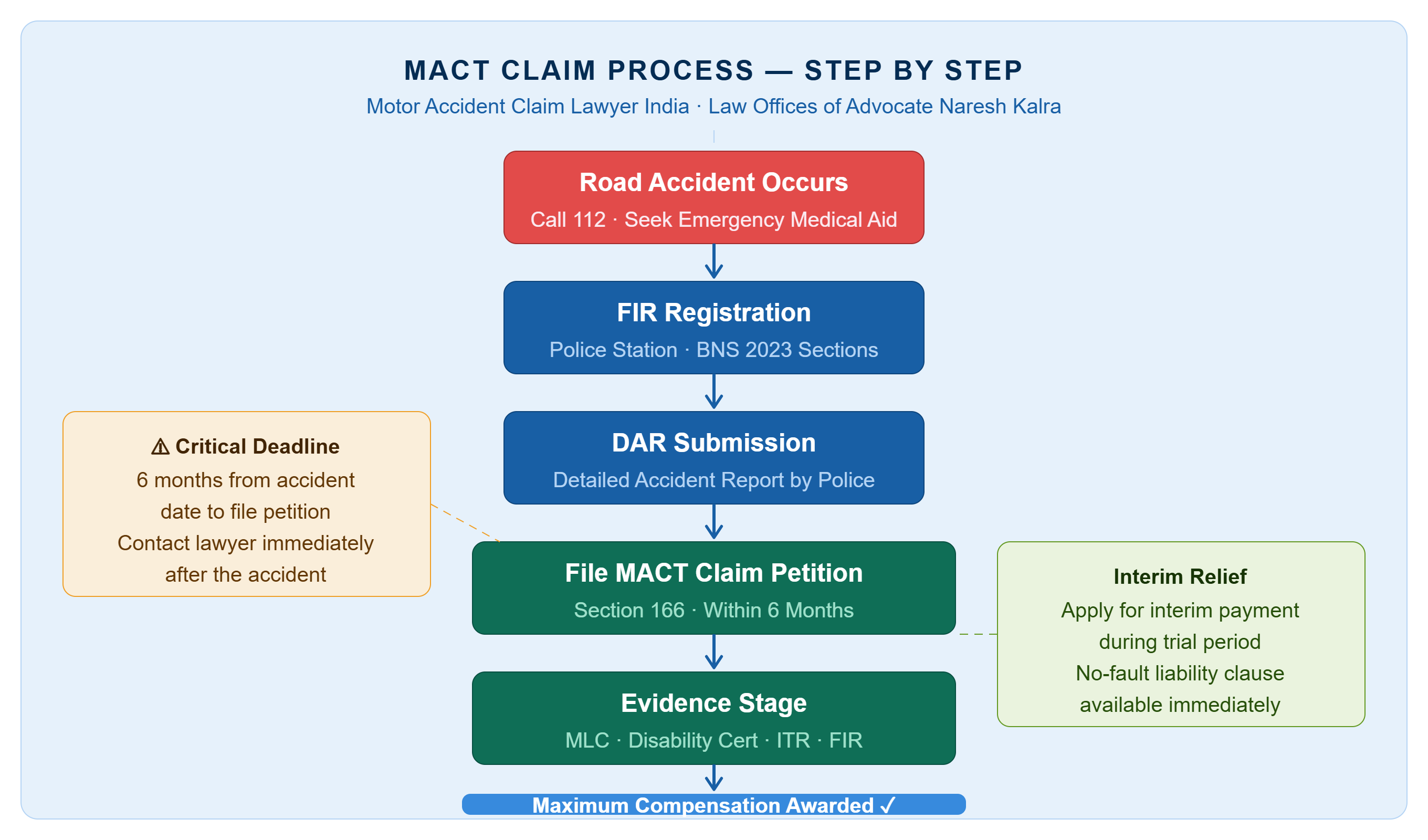
Clients repeatedly ask us how do you file a claim before the MACT — the process, while procedurally technical, follows a fairly predictable sequence once you know it. Here is how our motor accident claim lawyer India team typically walks a case from the accident scene to the final award
Throughout this sequence, we also pursue interim compensation wherever the facts permit, so our clients are not left without financial support purely because the final trial is still pending.
A successful claim relies entirely on cold, documented evidence. When you work with a top-rated motor accident lawyer India at our firm, we construct an unassailable dossier containing
Critical Legal Update for 2024-2025: The modern MACT system has drastically transformed the traditional, slow-moving claim process by introducing the mandatory Detailed Accident Report (DAR) system.
Under the updated guidelines, the investigating police officer is legally bound to submit a highly comprehensive DAR to the Claims Tribunal within a strict, short window from the date of the road accident. This report automatically consolidates the insurance validity, driver licensing details, vehicle registration status, and medical logs of the injured persons.
An agile motor accident case lawyer India steps in instantly during this critical phase. We cross-examine every entry in the DAR submitted by the police to ensure that
Clients from Chandigarh, Mohali, Panchkula, and Ludhiana particularly benefit from our team's established relationships with traffic police investigation departments and our ability to promptly intervene at the DAR stage before the first Tribunal hearing is even scheduled — an early intervention window that unrepresented claimants routinely lose because they simply do not know it exists.
Navigating insurance loops, transport department regulations, and judicial cross-examinations requires meticulous attention to detail. Here is why clients consistently choose our brand as their trusted motor accident claim lawyer India
Yes. If the offending vehicle is uninsured, the ultimate financial liability to pay the awarded compensation shifts directly onto the registered owner of that offending vehicle. Our firm aggressively attaches the personal assets and properties of the uninsured vehicle owner to secure your payout. In certain categories, the Insurer of Last Resort mechanism under IRDAI guidelines may also be triggered.
The Motor Vehicles (Amendment) Act, 2019 introduced a limitation period of 6 months from the date of the accident for filing a claim petition under Section 166(3), with a discretionary condonation-of-delay provision where the claimant shows sufficient cause. However, this is currently a live, evolving legal position rather than settled law: as of late 2025, the Supreme Court of India, while hearing a constitutional challenge to this 6-month limit, has passed an interim order directing that no MACT claim petition be dismissed as time-barred while the matter remains sub judice, with a final verdict on the provision's constitutionality still pending. In practical terms, this means claimants should not be told their claim is automatically barred solely because more than 6 months have passed — but the safest, most prudent course, and what we advise every client, is still to file as promptly as possible and not rely on this interim protection as a reason to delay.
Under the law, the claimant has multiple options. A petition can be filed before the MACT within whose local jurisdiction the accident occurred, where the claimant resides or carries out business, or where the offending vehicle owner resides. For residents of Chandigarh, Mohali, Panchkula, and Ludhiana, we identify the most strategically advantageous tribunal jurisdiction to file your claim for maximum efficiency.
The duration of a MACT case in India varies depending on the complexity of evidence, the number of witnesses, and the court's current docket load. Straightforward cases with clear evidence may conclude in 1 to 2 years, while complex multi-vehicle or fatal accident cases can take 3 to 5 years. As your dedicated road accident compensation lawyer India, we proactively pursue interim compensation from Day One so that you are not left without financial support during the pendency of the full trial.
Yes. Indian courts apply the principle of contributory negligence rather than absolute fault. Even if the victim was partially responsible for the accident, the tribunal will apportion liability percentage-wise and the victim can still recover a proportional compensation amount from the offending party. Our accident claim lawyer India team presents the most favorable factual reconstruction to minimize any contributory negligence attributed to our clients.
There is no fixed universal figure — compensation is calculated case by case using the multiplier method standardized in Sarla Verma v. Delhi Transport Corporation (2009) and National Insurance Co. Ltd. v. Pranay Sethi (2017). The tribunal takes the victim's net annual income, applies an age-based multiplier (broadly ranging from about 5 to 18 depending on age), adds a future-prospects component of 40%, 25%, or 10% of income depending on whether the victim was below 40, between 40-50, or between 50-60 years old, and then adds pecuniary heads like medical expenses and attendant charges plus standardized non-pecuniary heads like loss of consortium and loss of estate. The percentage of permanent disability, number of dependents, and quality of documentary evidence materially affect the final award.
No-fault liability, under Section 164 of the Motor Vehicles Act, 1988, allows a claimant to obtain fixed, structured compensation — currently Rs. 5,00,000 for death and Rs. 2,50,000 for permanent disability — without having to prove that the accident was caused by anyone's negligence. It exists precisely because proving fault can take time, and victims should not be left without any support while that process plays out. This no-fault amount is not paid in addition to a full fault-based award; it is adjusted against the final compensation determined in a Section 166 proceeding if one is also pursued, effectively functioning as fast, guaranteed interim relief.
The Compensation to Victims of Hit and Run Motor Accidents Scheme, 2022, framed under Section 161 of the Motor Vehicles Act and administered through the General Insurance Council, provides a government-backed fund for victims where the offending vehicle cannot be traced or is uninsured. Under the current scheme, legal heirs of a person killed in a hit-and-run accident can claim Rs. 2,00,000, and victims of grievous injury can claim Rs. 50,000. This route does not require identifying the driver or vehicle, making it a critical lifeline where the offending vehicle simply disappears from the scene.
In short: register an FIR and obtain a Medico-Legal Certificate immediately, consult a motor accident lawyer to evaluate the case and identify the correct respondents, file a detailed claim petition before the MACT with jurisdiction, respond to and scrutinize the police's Detailed Accident Report, lead evidence including medical and income proof, and argue the case to a final award — which can then be executed or appealed. A full walkthrough of each stage is set out in the "How to File a Claim Before the MACT" section above.
At a minimum, you need the FIR, the Medico-Legal Certificate and complete medical records (including a Disability Certificate from a Government Medical Board where applicable), income proof such as salary slips or Income Tax Returns, the vehicle's insurance, registration, and permit documents, and — wherever possible — photographs, video footage, and eyewitness statements gathered close to the time of the accident. In fatal cases, a post-mortem report and dependents' proof of relationship are also essential. Our full evidence checklist is set out in the "Critical Checklist of Evidence" section above.
Possibly — Indian courts have, in appropriate circumstances, permitted claimants to challenge a discharge voucher or an inadequate settlement where it was signed under financial distress, without full information, or without independent legal advice, particularly where the sum accepted is grossly disproportionate to the actual loss. This is a fact-specific and legally technical argument, so it is important to have a motor accident lawyer review exactly what was signed and under what circumstances before assuming the matter is closed. This is also precisely why we recommend an independent case review before signing anything an insurer presents.
Yes. Contact Mr. Harish Tiwari from the Naresh Kalra Legal Team at +91-9815580037 to discuss your case and schedule your initial Free consultation.