Society Registration in India: Complete Guide
Society Registration in India allows a collective of individuals to establish a legally recognized entity
dedicated to advancing non-profit objectives—whether educational, cultural, charitable, religious, or scientific.
Societies are primarily governed by the Societies Registration Act, 1860, which lays out the legal framework for
their formation, governance, and accountability.
Contents
What is Society Registration?
A society is a legal collective of individuals unified for a shared, non-commercial purpose. These entities are
primarily established to support causes such as education, public welfare, arts, culture, science, and religion.
Registration provides a legal identity, enabling societies to function more effectively.
Key Characteristics:
- Non-Profit Focus: Operations are geared toward public good rather than generating profits.
- Minimum Membership: At least seven founding members are required.
- State-Level Registration: Registration must be completed with the state’s Registrar of Societies.
Common Objectives:
- Promoting literacy, learning, and academic projects.
- Supporting underprivileged communities.
- Organizing events related to arts, science, or social development.
- Environmental and rural upliftment initiatives.
Types of Societies:
- Cultural Societies: Focused on preserving and promoting heritage and traditions.
- Educational Societies: Running institutions or providing training and literacy.
- Religious Societies: Supporting religious outreach and community activities.
- Sports Societies: Aiming to develop athletics and sports education.
- Welfare Societies: Working for social justice and equitable development.
Timeline for Society Registration
The duration can vary, but the typical processing time ranges from 15 to 60 days.
Influencing Factors:
- State-Specific Rules: Some states have faster or more digitalized systems.
- Document Accuracy: Well-prepared applications move faster.
- Registrar Workload: Internal administrative timelines also matter.
A properly filed application often sees approval within 30–45 days.
Advantages of Registering a Society
Registering a society provides multiple strategic and legal benefits:
- Legal Recognition: Enables contract execution and asset ownership.
- Tax Benefits: Eligibility for exemptions under Sections 12A and 80G of the Income Tax Act.
- Access to Grants: Easier access to public and international funding sources.
- Public Trust: Enhances transparency and credibility with stakeholders.
- Limited Liability: Protects members from personal responsibility for liabilities.
- Networking: Grants access to institutional resources and development opportunities.
Governance Structure
A well-defined governance system is central to a registered society’s functionality:
- Governing Body: An elected committee oversees operations and strategic planning.
- Meeting Protocols: Regular meetings promote transparency and accountability.
- Decision-Making: Should follow structured rules, including quorum and voting methods.
- Financial Oversight: Accurate financial records and periodic audits are essential.
Common Challenges in Society Formation
Despite the benefits, forming a society can present some hurdles:
- Document Complexity: Legal drafting can be difficult without professional help.
- Delays: The approval process may be prolonged due to state-level bureaucracy.
- Compliance Burden: Ongoing legal and financial compliance is resource-intensive.
- Funding Struggles: New societies often lack immediate access to stable funding.
Other Legal Structures for Non-Profits
If society registration doesn’t align with your goals, consider alternatives:
- Trusts: More flexible in some respects and governed under the Indian Trusts Act.
- Section 8 Companies: Formed under the Companies Act, 2013, and often preferred for larger or institutional operations.
Managing a Registered Society Effectively
For long-term impact and sustainability, consider the following strategies:
- Vision Planning: Develop a strong mission, measurable goals, and execution roadmap.
- Community Engagement: Build lasting relationships with donors, volunteers, and the public.
- Capacity Building: Train and empower team members and office bearers.
- Fundraising: Craft a structured fundraising strategy involving events, CSR, and digital platforms.
- Monitoring & Evaluation: Track progress and revise initiatives based on outcomes.
- Transparency: Maintain open communication through reports and disclosures.
Final Thoughts
Establishing a society is a valuable tool for those looking to contribute to social development, education, or culture. By
understanding the process
and adhering to legal norms, societies can expand their reach, build trust, and achieve significant social impact.
How We Support Society Registration
The firm offers professional support for individuals or groups looking to register a society in India:
- Expert Consultation: Guidance on documentation, registration laws, and compliance.
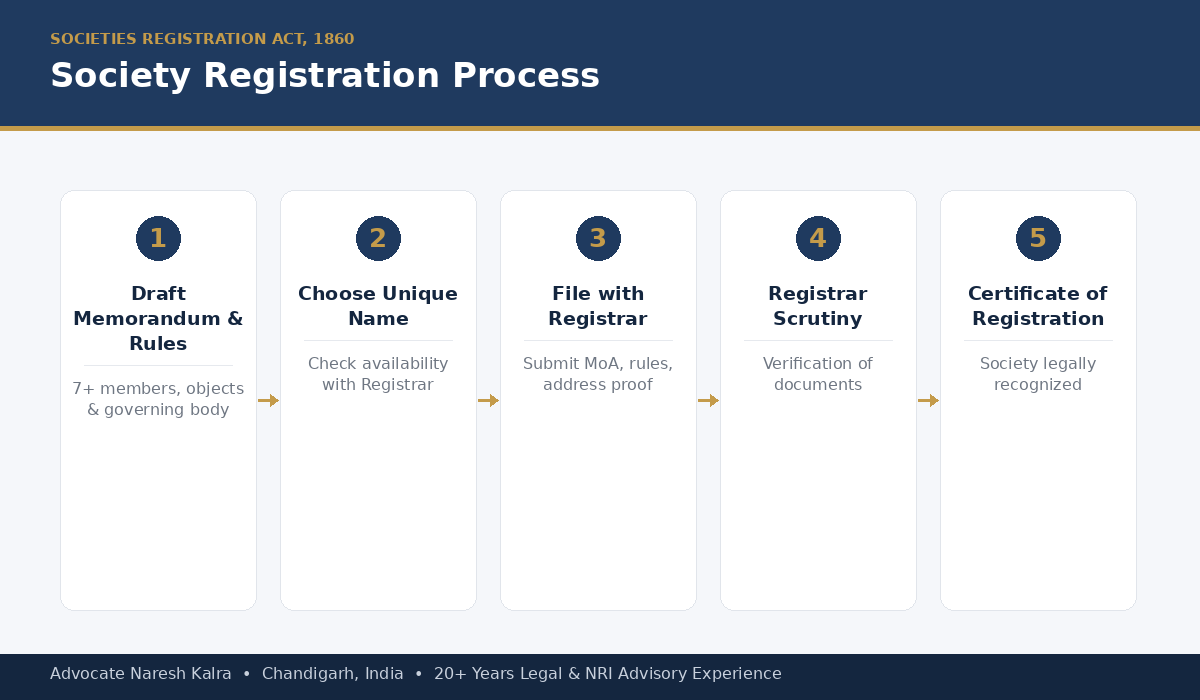
- Document Assistance: Help with drafting and organizing the MoA and operational rules.
- Filing & Submission: Filing applications with the Registrar, avoiding clerical errors.
- Status Tracking: Real-time updates and support with follow-ups.
- Post-Registration Services: Help with ongoing legal compliance, record maintenance, and governance.
Nationwide Operation and Name Protection
Can a Registered Society Operate Nationally?
Yes, a registered society can expand operations across India. However:
- Local Compliance: States may require secondary registrations for active operations.
- Multi-State Licensing: Necessary for events, fundraising, or regulated activities.
- Annual Returns: Must be filed consistently as per the applicable state rules.
Can Two Societies Have the Same Name?
Since societies are registered at the state level, identical names can exist in different states. This can result in:
- Brand Confusion: Especially during fundraising or awareness campaigns.
- Legal Disputes: Over identity and operational overlap.
Best Practice: Select a distinctive name and consider trademark registration to secure national exclusivity.
Income Tax Rebate on Donations to Societies
Eligibility for Donor Deductions:
Donations to societies recognized under Section 80G are eligible for tax deductions:
- 100% Deduction: For donations to select government-notified institutions.
- 50% Deduction: For general charitable contributions to eligible societies.
Conditions:
- Donations above ₹2,000 must be made via cheque, draft, or online transfer.
- A valid 80G certificate and receipt must be provided by the society.
- The deduction cannot exceed the donor’s taxable income.