Complete Guide to Acquiring an NBFC: 7 Simple Steps
Purchasing a Non-Banking Financial Company (NBFC) offers a fast-track route to entering the financial services market. Instead of
navigating the prolonged and complex process of securing a fresh license, acquiring an NBFC already operating with Reserve Bank of
India (RBI) approval can help a business scale quickly. Whether you're looking for an NBFC license for sale, an operational NBFC
company for sale, or considering an NBFC for takeover, this
strategy opens access to established infrastructure, clientele, and compliance systems—saving valuable time and enabling faster expansion.
Strategic Value of Buying an NBFC
Acquiring an existing NBFC is a forward-thinking strategy for businesses wanting to broaden their service offerings or
geographical footprint. With an RBI-approved NBFC license already in place, the buyer can skip regulatory red tape and
move swiftly into operations.
When a company purchases an NBFC available for sale, it instantly gains access to a functional business model, systems,
and a ready customer base. This minimizes startup delays, accelerates revenue generation, and allows for operational
scaling. Moreover, buying an NBFC for takeover can yield cost efficiencies and unlock cross-selling opportunities
across financial verticals.
However, success hinges on rigorous due diligence—assessing loan books, risk exposure, and regulatory standing. RBI
approval is mandatory, and integration challenges must be managed with precision.
NBFC Purchase Guide by Advocate Naresh Kalra
Contents
Understanding NBFCs
Non-Banking Financial Companies (NBFCs) play a pivotal role in India’s financial framework. These institutions offer credit,
investment, and asset management services to individuals and enterprises, often in areas under-served by traditional banks. For
entrepreneurs or corporates seeking to branch into financial services,
purchasing an existing NBFC provides an ideal entry point—complete with systems, licensing, and a client base already in place.
What Does an NBFC for Sale Mean?
An NBFC for sale is an operating financial entity being offered for acquisition, typically along with its license, books of accounts,
operational systems, and clientele. Purchasing such a company allows a buyer to bypass the RBI licensing process and begin operations
immediately. These
ready-made financial vehicles are especially attractive to businesses that prioritize speed, compliance, and reduced regulatory friction.
Regulatory Requirements for Buying an NBFC
All NBFC acquisitions require prior clearance from the Reserve Bank of India. The acquirer must prove their financial soundness,
managerial competency, and commitment to regulatory compliance. KYC norms, Anti-Money Laundering (AML) rules, and reporting standards
must be
maintained throughout. These safeguards ensure that the Indian financial ecosystem remains transparent, secure, and investor-friendly.
Key Benefits of Buying an NBFC
- Accelerated Market Entry: An NBFC license for sale eliminates the waiting time and complexity of fresh registration.
- Established Systems and Staff: Buyers inherit a functioning structure, including employees, policies, and client handling systems.
- Access to Clients: Immediate access to existing loan portfolios and customers supports faster revenue realization.
- Operational Efficiency: Using a proven model reduces the learning curve and supports faster scaling.
- Geographical Reach: Takeovers often bring a regional presence that would otherwise take years to build organically.
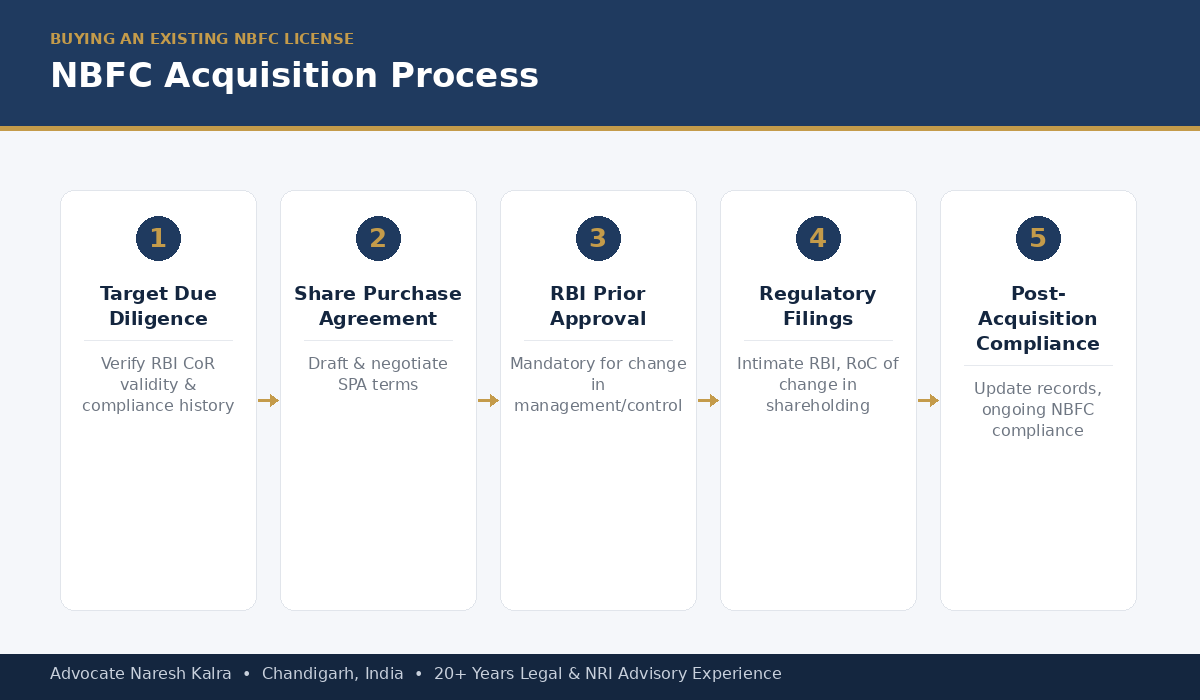
Step-by-Step Process to Acquire an NBFC
Due Diligence
Assess financial records, assets, liabilities, litigation history, loan books, and
compliance levels to identify potential red flags.
Valuation
Evaluate the fair market value using Net Asset Valuation (NAV), Comparable Transactions, or Discounted Cash Flow (DCF) analysis.
Negotiation
After valuation, buyers and sellers negotiate terms including purchase price, warranties, and indemnities.
Regulatory Approval
Submit an acquisition proposal to the RBI with required documentation and await clearance.
Integration
Post-approval, align the NBFC’s processes, culture, systems, and team with the buyer’s organization for smooth functioning.
Common Challenges in the Acquisition Process
Acquiring an NBFC is not without hurdles. The most common challenges include:
- Delays in RBI Approval
- Valuation Disputes Between Buyer and Seller
- Cultural or Management Misalignment
- Legacy Liabilities or Credit Risks in the Loan Book
- System Integration or Staff Retention Issues
Mitigating these risks requires thorough planning and expert assistance.
Recent Trends in NBFC Acquisitions
The NBFC acquisition space is witnessing strong interest, particularly from tech-savvy businesses and international
investors. Digital finance players are acquiring NBFCs to fast-track lending operations. Many FinTech firms are also
investing in NBFCs to
integrate technology into legacy finance systems, utilizing tools like AI, data analytics, and blockchain to modernize
customer experiences.
Final Thoughts
Acquiring an NBFC available for sale is a strategic move with strong growth prospects. The key is careful evaluation, strict regulatory
compliance, and effective post-acquisition integration.
With a proactive approach, companies can gain a competitive edge and quickly carve out a space in India’s dynamic financial landscape.
Why Our Firm is the Right Choice for Your NBFC Acquisition
The firm offers specialized legal and financial services tailored for NBFC acquisitions. Here's why businesses trust the firm:
NBFC-Specific Expertise
The firm has a proven track record in handling NBFC sale and transfer transactions with regulatory finesse and legal precision.
End-to-End Advisory
From sourcing the right NBFC for sale to conducting due diligence, securing RBI clearance, and completing integration, the firm manages it all.
Seamless RBI Compliance
The firm ensures full adherence to RBI norms, including AML, KYC, and reporting mandates.
Custom Acquisition Strategies
Every business has unique needs—the firm designs tailored acquisition plans aligned with your financial goals and operational strengths.
Cost & Time Efficiency
Their structured approach ensures minimal delays and optimized resource usage.
Strong Industry Network
With connections across India's financial ecosystem, the firm helps you find the right NBFC for sale based on your criteria.
Risk Management
Comprehensive risk assessments reduce exposure to bad loans, legal claims, or compliance breaches.
Post-Acquisition Support
The firm continues offering support during integration—covering legal compliance, HR, documentation, and system adaptation.
Reliable Partner
The firm success across NBFC projects demonstrates reliability, transparency, and results-oriented execution.
Complete Business Solution Provider
Beyond NBFC acquisition, the firm delivers related services including business registrations, tax filings, IP protection, M&A, and legal compliance.
Why We Are a Trusted Partner Across Legal & Business Services
The firm isn’t just your NBFC guide—they offer an extensive portfolio covering:
- Company Incorporation
- GST Filing and Registration
- Trademark & IP Registration
- NGO & Trust Registration
- Financial Due Diligence
- Corporate Restructuring
- Business Loan Advisory
- Labor Law Consulting
- Dispute Resolution
- Taxation & Audit Services
- Legal Contracts & Drafting
The firm expert-led, technology-powered service
delivery ensures businesses of all sizes receive timely,
cost-effective, and reliable solutions under one roof.