--->

Divorce in India as an NRI — Mutual Consent, Without Flying Back

Deciding to end a marriage is hard enough without the added weight of a legal system on the other side of the world. If you're an NRI reading this, you may already be carrying that weight — wondering whether you even can file for divorce from where you live now, whether a decree from your country of residence will mean anything back in India, whether you'll have to leave your job and fly back for months, and what happens to your children or your finances while all of this is unresolved. These are not small questions, and they don't have generic answers. Where your marriage was solemnized, where you last lived together, where your spouse lives now, and which country's courts you approach first can each change the entire path forward.

Advocate Naresh Kalra has practised family law for over 20 years, appearing directly before family courts in Chandigarh, Mohali, and across Punjab — the region where many NRI marriages were solemnized and where the matrimonial home, in-laws, or contested assets often still sit. That local courtroom presence matters more in family law than in almost any other area of NRI legal work, because these are not paper transactions handled through a Power of Attorney; they are proceedings before a judge, with a spouse who may live nearby, in a court system that rewards a lawyer who is known, present, and prepared. Whether your matter is a straightforward mutual consent divorce or a genuinely contested one involving custody or property, this guide sets out the framework honestly — including what is realistically possible without travel, and what usually still requires it.

Section 13B

Hindu Marriage Act — Mutual Consent Route

6 Months

Standard Cooling-Off Period — Waivable in Appropriate Cases

Video-Conferencing

Increasingly Permitted — Not Guaranteed in Every Court

Not Automatic

Foreign Divorce Decree Recognition in India

20+ Years

Family Law & Courtroom Experience

Chandigarh, Mohali & Punjab

Family Courts Appeared Before Directly

Most Stages

Coordinated via Video Call, Email & WhatsApp

Confidential

Discreet Handling of a Sensitive Matter
🌍

The Jurisdiction Question — India or Abroad?

This is usually the very first question, and often the most consequential one. It is not simply a matter of choosing whichever country feels more convenient — Indian courts apply specific jurisdictional tests, and filing in the wrong forum, or assuming a foreign proceeding will simply be accepted back home, can cost months or years later. As a general framework, Indian courts typically have jurisdiction to entertain a divorce petition where any one of the following applies:

Jurisdictional BasisWhat It Generally Means
Marriage was solemnized in IndiaIndian courts can generally exercise jurisdiction even if both spouses currently reside abroad, since the marriage itself was performed within India
The couple last resided together in IndiaIf the last shared matrimonial home was in India — even if one or both spouses have since moved abroad — Indian courts can generally take up the matter
The respondent spouse resides in IndiaA petition can generally be filed before the court having jurisdiction over where the spouse being sued for divorce currently lives
The petitioner alone resides abroad, with no other India connectionResiding abroad, by itself, does not automatically confer jurisdiction on Indian courts if none of the above factors apply — the specific facts of the marriage decide this, not convenience

The reverse question — whether a divorce decree obtained abroad will be recognised as valid in India — is where many NRIs are caught off guard. A foreign decree's validity in India is not automatic. Indian courts examine it, broadly, along the same lines the Civil Procedure Code sets out for recognising any foreign judgment: was it passed by a court of competent jurisdiction as understood under Indian conflict-of-laws principles; was it decided on the merits after genuine participation by both parties, rather than an ex-parte order passed because the other spouse simply never appeared or was never properly served; was the decree obtained through fraud; and does it offend natural justice or the substance of Indian matrimonial law where that law governs the marriage. Indian courts have repeatedly scrutinised foreign divorce decrees on exactly these grounds — ex-parte decrees, and decrees granted on a ground not recognised under the law governing the marriage (such as an irretrievable-breakdown-only divorce granted abroad against a spouse who never contested it), are the ones most likely to run into trouble when later relied upon in India.

WHY THIS MATTERS

An NRI who obtains a quick, uncontested divorce decree abroad — believing the matter is closed — can later find that decree challenged or simply not recognised in India, particularly if the other spouse never genuinely participated in that foreign proceeding. Before choosing where to file, get a candid assessment of how that decree will hold up in India, especially if any property, remarriage, or custody question will eventually need to be resolved on Indian soil.

↑ Back to top

🤝

Mutual Consent vs. Contested Divorce

Once jurisdiction points toward India, the next fork is whether both spouses genuinely agree that the marriage should end. This single fact — agreement or disagreement — changes almost everything about timeline, cost, and how much of the process can be handled without either spouse being physically present.

AspectMutual Consent (Section 13B, HMA)Contested Divorce
BasisBoth spouses agree the marriage has broken down and jointly petition the courtOne spouse files; the other opposes, or the underlying facts are disputed
GroundsNo fault needs to be proven — mutual agreement and a period of living separately is sufficientA specific legal ground must be proven — cruelty, desertion, adultery, or another recognised ground
Typical timelineOften 6 to 18 months, including the statutory cooling-off periodFrequently 2 to 5+ years, depending on contest, evidence, and any appeal
Cooling-off periodA statutory waiting period ordinarily applies between the first and second motions; courts have held it can be waived in appropriate cases where reconciliation is clearly not possibleNot applicable in the same way — the case proceeds through pleadings, evidence, and trial
Emotional & financial costConsiderably lower — fewer hearings, less adversarial process, faster closureSignificantly higher — prolonged litigation, repeated hearings, and greater legal expense
NRI travel burdenMinimal in most cases — often as few as one or two court appearances, frequently permitted via video-conferencingHigher — cross-examination and evidence recording in a genuinely contested matter typically still call for physical presence

Where both spouses are willing, a mutual consent divorce is almost always the faster, less painful, and less expensive route — and it is the route where remote participation is most realistically possible. Where one spouse is not willing, or where custody, property, or maintenance remain genuinely disputed, a contested divorce is sometimes unavoidable, and honest planning around timeline and travel becomes essential from the outset.

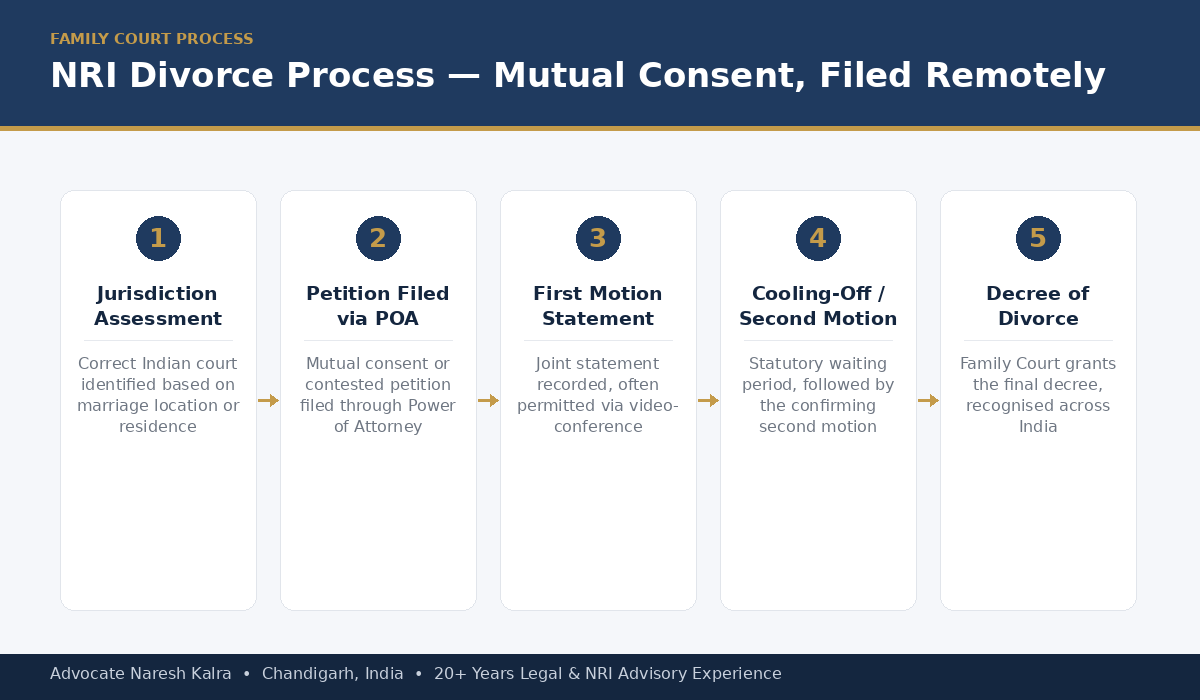
NRI divorce process — mutual consent, filed remotely via Power of Attorney, from jurisdiction assessment to final decree

↑ Back to top

💻

Video-Conferencing & Remote Hearings — Realistic Expectations

This is the question we are asked most often, and it deserves an honest answer rather than a marketing one. Indian courts, including family courts, have genuinely expanded their use of video-conferencing over the past several years — accelerated by the pandemic and supported by e-Courts infrastructure that now exists in most district and family courts. For mutual consent divorce specifically, it has become increasingly common for one or both spouses to record their statements before the court over video link rather than travelling in person, and several High Courts and family courts have actively facilitated this for NRI litigants.

That said, this is not a guarantee, and any lawyer who promises "no travel, ever, in any scenario" is not being fully honest with you. Whether video-conferencing is permitted, and for which stages, depends on the specific court, the presiding judge's discretion, the nature of the hearing, and how the matter is presented. A short, procedural hearing or a mutual consent statement is far more likely to be permitted remotely than a contested trial involving cross-examination of witnesses, where a judge's ability to assess credibility in person is often considered important. Practically, here is what tends to hold true:

Our practice is built to minimise your travel wherever the court genuinely permits it, and to tell you plainly, upfront, when a particular hearing will realistically require you to be physically present — so you can plan your work and family commitments around real expectations, not optimistic ones.

↑ Back to top

👶

Child Custody When Children Are Abroad

When children are involved and living abroad, custody becomes the most emotionally difficult and legally intricate part of an NRI divorce. Indian courts, like courts everywhere, apply the child's best interest as the guiding standard — but where the child actually lives, and which country's courts have practical authority to enforce an order, adds real complexity on top of that standard.

If children are part of your situation, the most protective step is almost always to seek advice before taking any unilateral action — including before a planned trip, a move, or a change in where the children are staying — rather than after.

↑ Back to top

💰

Maintenance & Alimony for NRI Spouses

Maintenance and alimony questions in NRI divorces carry an added layer of complexity that purely domestic cases usually don't: courts frequently need to assess income, assets, and standard of living that exist partly or wholly outside India.

↑ Back to top

📍

Our Courtroom Strength in Chandigarh, Mohali & Punjab

Family law, more than almost any other practice area, is a courtroom discipline — it is decided in front of a judge, not settled through paperwork alone. For NRIs whose marriage was solemnized in the Chandigarh–Mohali–Punjab region, whose in-laws or matrimonial home are still here, or whose spouse currently resides here, having counsel who appears before these specific courts regularly is a genuine, practical advantage.

↑ Back to top

📁

A Case From Our Practice

The Situation: An NRI client based in the United Kingdom had been married in Mohali and had lived with her spouse in India for only a short period before relocating abroad for work. The couple had been separated for over two years and both genuinely wanted a mutual consent divorce, but the client was anxious about the time and cost of repeated trips to India, and unsure whether an Indian court would even accept the case given how briefly the couple had actually lived together in India.

What We Did: We confirmed jurisdiction on the basis that the marriage was solemnized in India and the parties' last shared residence, however brief, had been in Mohali. Working with counsel for the other spouse, we prepared a joint mutual consent petition, negotiated an agreed one-time settlement covering maintenance, and applied for the statutory cooling-off period to be waived given the length of separation and clear absence of any prospect of reconciliation.

The Outcome: The client was able to record her statement before the Family Court via video-conferencing for both motions, appearing in person only once, for a short formal step the court required physically. The matter concluded well within a year of filing, without the client needing to take extended leave from her job abroad.

This account is anonymised and details have been altered to protect client confidentiality. Every marriage and every case turns on its own specific facts, and outcomes — including whether cooling-off is waived or video-conferencing is permitted — depend on the specific court and circumstances, and cannot be guaranteed in any other matter.

↑ Back to top

Facing a Divorce From Abroad? Talk to Someone Who Understands Both the Law and the Distance.

Get an honest, confidential assessment of your jurisdiction, your realistic timeline, and how much of the process can genuinely be handled without travelling back — from an advocate with direct courtroom experience in Chandigarh, Mohali, and across Punjab.

Why NRIs Choose Advocate Naresh Kalra

20+

Years of Family Law & Courtroom Experience

Direct

Personal Appearances in Chandigarh, Mohali & Punjab Courts

Honest

Realistic Guidance on Travel & Video-Conferencing — No False Promises

Confidential

Discreet, Compassionate Handling of Sensitive Family Matters

Frequently Asked Questions (FAQs)

Can I file for divorce in India if I live abroad?

Yes, in many situations. Indian courts generally have jurisdiction if the marriage was solemnized in India, if the couple's last shared residence was in India, or if the respondent spouse currently resides in India. Living abroad yourself does not prevent you from filing — but the specific facts of your marriage determine which court has jurisdiction, so it's worth confirming this before you file.

How do I get divorced if my spouse lives in another country?

This adds genuine complexity, particularly around properly serving legal notice on a spouse abroad and, in a contested matter, coordinating evidence and hearings across two countries. It is usually still achievable — through proper international service of process and, where both parties are willing, a mutual consent route — but it strongly benefits from experienced counsel who can manage the jurisdictional and procedural coordination rather than leaving you to navigate it alone.

Is a divorce obtained in the USA, UK, or Canada automatically valid in India?

Not automatically. Indian courts examine a foreign divorce decree along lines similar to how any foreign judgment is assessed — including whether it came from a court of competent jurisdiction, whether both spouses genuinely participated (as opposed to an ex-parte decree), and whether it was obtained through fraud or offends natural justice or the substance of the law governing the marriage. Ex-parte foreign decrees, in particular, have repeatedly faced challenges when later relied upon in India.

Can an NRI file for and complete a divorce in India entirely from abroad, without visiting India?

Increasingly, yes for many stages — particularly in mutual consent matters, where courts have permitted spouses to record their statements via video-conferencing. But this is not guaranteed for every hearing in every court, and a genuinely contested case involving cross-examination of witnesses will usually still require physical presence at some stage. We give clients an honest assessment of what's realistically remote and what isn't, rather than a blanket promise.

How does mutual consent divorce differ from contested divorce in speed and process?

Mutual consent divorce, where both spouses agree, typically takes around 6 to 18 months, involves far fewer hearings, and does not require proving fault. A contested divorce, where one spouse disputes the case or a specific ground must be proven, commonly takes 2 to 5 years or longer, with more hearings, evidence, and expense.

What happens to child custody when one parent lives abroad?

Courts apply the child's best interest as the guiding standard, but practical authority over the child is closely tied to where the child actually lives, and enforcement of an Indian order against a child abroad depends on cooperation from courts in that country. Interim custody and visitation arrangements can usually be sought early, and unilaterally relocating a child without consent or a court order should be avoided, as it can seriously damage your position in both countries' proceedings.

Is maintenance or alimony calculated differently for NRI spouses?

The underlying legal principles are the same, but courts often need to assess a wider financial picture — including income, assets, and standard of living held abroad, not just what is visible in India. Enforcing an Indian maintenance order directly against a spouse with no assets in India can also be genuinely difficult, which is why a negotiated mutual consent settlement often resolves this more cleanly than prolonged litigation.

Do you offer a free legal consultation?

Yes. Contact Mr. Harish Tiwari from the Naresh Kalra Legal Team at +91-9815580037 to discuss your case and schedule your initial Free consultation.

Whatsapp Chat