Section 8 NGO Registration: Trusted Legal Support for Non-Profits
Registering as a Section 8 Company empowers individuals and groups to establish a non-profit organization dedicated to
charitable, educational, or social objectives, while enjoying income tax exemptions and formal legal status. This process
involves reserving a name, preparing incorporation documents, securing a license from the Ministry of Corporate Affairs
(MCA), and fulfilling post-registration compliance.
A properly registered Section 8 NGO gains legitimacy, qualifies for government and CSR grants, and enjoys exemptions under
key provisions of the Income Tax Act. With expert legal support, you can streamline the application process, avoid
compliance pitfalls, and ensure timely registration. Professional assistance ensures every document is accurate and
filed correctly—setting your NGO up for long-term success.
Guide to Section 8 Company Formation: Legal Help for Charitable Entities
Starting a Section 8 NGO is ideal for those focused on promoting social welfare, education, public health, arts, or
environmental conservation. Section 8 Companies receive several advantages over traditional trusts and societies,
especially in terms of legal status and tax efficiency.
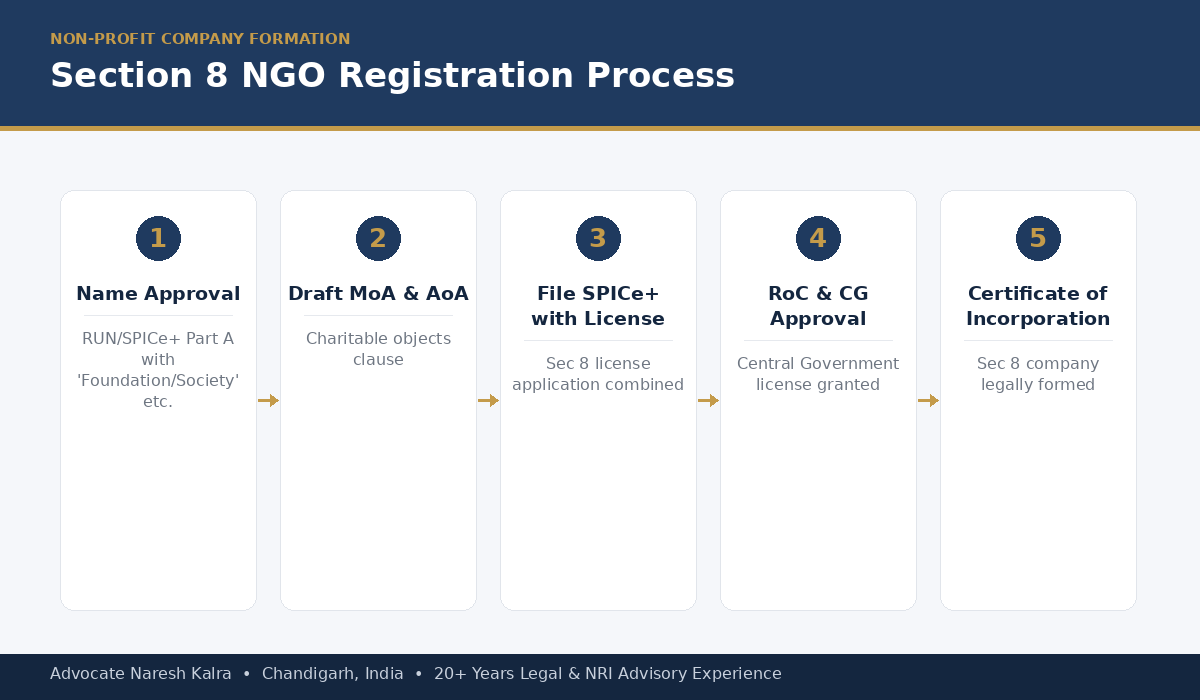
The registration includes several key steps: getting MCA name approval, submitting incorporation paperwork including
the MOA and AOA, obtaining a Section 8 license under the Companies Act, 2013, and staying aligned with financial and
legal compliance standards.
Once incorporated, a Section 8 NGO becomes eligible for benefits such as tax exemptions under Sections 12A and 80G of
the Income Tax Act, access to public and private funding, and greater trust from donors and partners. These entities
are not bound by minimum capital requirements and reinvest all earnings into the organization's core mission.
Compliance is a cornerstone of sustainability—NGOs must maintain financial records, submit annual returns, and meet
regulatory standards enforced by the MCA and Income Tax Department. Legal experts help navigate these rules, enabling
smooth incorporation and ongoing compliance.
By leveraging expert Regulatory and Compliance Issues, founders can focus on impact while professionals handle registration and reporting.
Whether you're launching a new NGO or formalizing an existing group, choosing the right structure and complying with legal
requirements is essential to your cause’s success.
Contents
Overview
A Section 8 Company—recognized under the Companies Act, 2013—is a non-profit organization registered to promote
activities like education, science, culture, and social welfare. Unlike informal groups or unregulated entities,
Section 8 Companies are structured for accountability and credibility, making them more attractive to donors,
government bodies, and institutional partners.
This comprehensive guide explains how to register a Section 8 NGO in India, the legal benefits, tax exemptions,
and why this structure stands out among other charitable setups.
Key Benefits of Section 8 NGO Registration
Legal Entity Status
A Section 8 Company is a recognized legal entity under Indian law, improving credibility and operational trustworthiness.
Limited Liability Protection
Members' personal assets are protected, even if the NGO faces financial or legal obligations.
Continuity of Operations
The organization remains in existence even if leadership or members change over time.
Income Tax Benefits
Eligible for exemptions under Sections 12A and 80G, encouraging tax-free donations and income.
Funding Access
Eligible to apply for CSR funds, government schemes, and foreign contributions.
Strong Governance Structure
Operates with a formal board and audit requirements, encouraging transparency and accountability.
Why Choose a Section 8 Company Over Trusts or Societies?
Section 8 Companies offer superior legal recognition, ease of compliance, and better funding
opportunities than trusts and societies. They are more formally governed, making them ideal for
long-term institutional partnerships.
Section 8 NGO Registration Process: A Step-by-Step Breakdown
Step 1: Get Digital Signature Certificate (DSC)
All proposed directors need a DSC to file documents online with MCA.
Step 2: Apply for Director Identification Number (DIN)
DIN is mandatory for all directors and must be obtained from MCA.
Step 3: Reserve a Unique Name
Propose and reserve your company name via the RUN (Reserve Unique Name) facility.
Step 4: Draft Incorporation Documents
Prepare the MOA and AOA outlining the organization’s objectives and internal rules.
Step 5: File Incorporation with MCA
Submit Form INC-32 (SPICe+) along with MOA and AOA to the Registrar of Companies.
Step 6: Receive Certificate of Incorporation
Upon approval, the ROC issues a Certificate of Incorporation with a CIN (Corporate Identity Number).
Step 7: Apply for PAN & TAN
Complete registration by obtaining your NGO’s PAN and TAN for income tax compliance.
Documents Needed for Registration
For Each Director
- PAN Card
- Aadhaar Card
- Passport (if available)
- Address Proof (Voter ID/Utility Bill/Bank Statement)
- Passport-sized photo
For the NGO
- Office address proof (Electricity Bill or Rent Agreement + NOC)
- Details of authorized capital and shareholding (if applicable)
- Statement of charitable objectives
12A & 80G Tax Certifications
Section 12A
Enables NGOs to be exempt from income tax on surplus income. It ensures the income is used strictly for
non-profit objectives.
Section 80G
Allows donors to claim deductions on donations made to the NGO, encouraging higher contributions.
Can a New NGO Get 12A & 80G?
Yes. New NGOs can apply for 12A and 80G after completing their incorporation. The process involves submitting
an online application and supporting documents like registration proof, PAN, details of activities, and financials.
CSR, NITI Aayog & E-Anudaan for Section 8 NGOs
- CSR Registration: Enables funding under Corporate Social Responsibility rules for eligible companies.
- NITI Aayog NGO Darpan: Mandatory for applying for government welfare schemes.
- e-Anudaan Portal: Web platform to apply for and manage government grant applications.
Compliance Requirements for Section 8 Companies
- Annual Filing: File annual returns with RoC within 60 days of the Annual General Meeting.
- Audit Obligations: Annual audits are mandatory to maintain financial transparency and compliance.
Final Thoughts
Section 8 NGO registration offers unmatched legal and tax advantages for entities aiming to drive social change.
From formal recognition to funding eligibility, this structure is ideal for those serious about long-term impact.
With the right guidance and legal support, establishing a Section 8 NGO becomes a seamless process, laying the groundwork
for compliance, growth, and public trust.
Why Register Your NGO with Us?
- Legal Expertise: Skilled professionals simplify the process.
- End-to-End Support: From documentation to post-registration assistance.
- No Hidden Fees: Transparent pricing.
- Extended Services: Trademark registration, GST, IP protection, trust/society registration, legal contracts, and more.