Starting a business independently no longer means compromising on legal protection. A One Person Company bridges the gap between sole proprietorship and a full corporate entity — giving individual founders limited liability, a separate legal identity, and perpetual succession, all while remaining sole owner and director. But registering correctly, and understanding what has changed in recent years, requires genuine legal guidance. This is exactly why solo entrepreneurs across Punjab work with a dedicated OPC Registration Lawyer India from the outset.
At the Law Offices of Advocate Naresh Kalra, we guide solo founders, consultants, and individual entrepreneurs through complete OPC incorporation and ongoing compliance across Chandigarh, Mohali, Ludhiana, and Pan-India. Our OPC Incorporation Lawyer India practice ensures your business is structured correctly from the very first filing — and stays current with the significant regulatory changes that have reshaped this structure since its introduction.
Introduced under the Companies Act, 2013, a One Person Company is a private limited entity formed by a single individual who acts as both shareholder and director — unlike traditional private companies, which require at least two members. This structure was specifically designed to encourage formalization of India's growing base of individual entrepreneurs and MSMEs. As your One Person Company Advocate India in Chandigarh, we highlight the core characteristics that make this structure valuable:
This is the question every solo founder asks before registering, and the answer depends on how seriously you're building the business:
To incorporate an OPC in India, specific conditions apply — and several were significantly liberalized by the Companies (Incorporation) Second Amendment Rules, 2021:
Our team ensures the following documentation is properly prepared before filing:
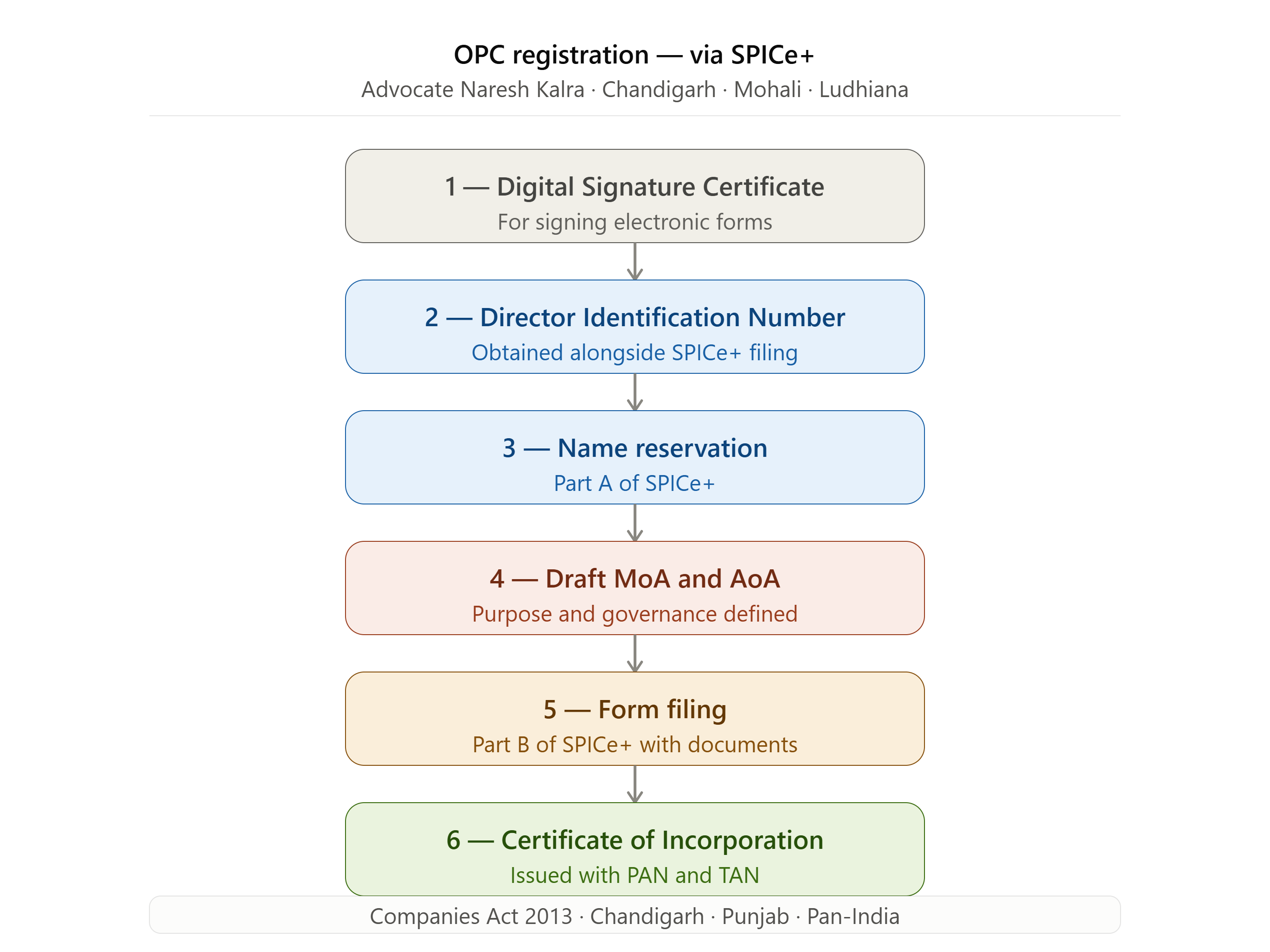
OPC incorporation is now fully integrated through the government's SPICe+ platform, combining name approval, incorporation, and PAN/TAN issuance into a single streamlined process. Our OPC Incorporation Lawyer India team manages every stage:
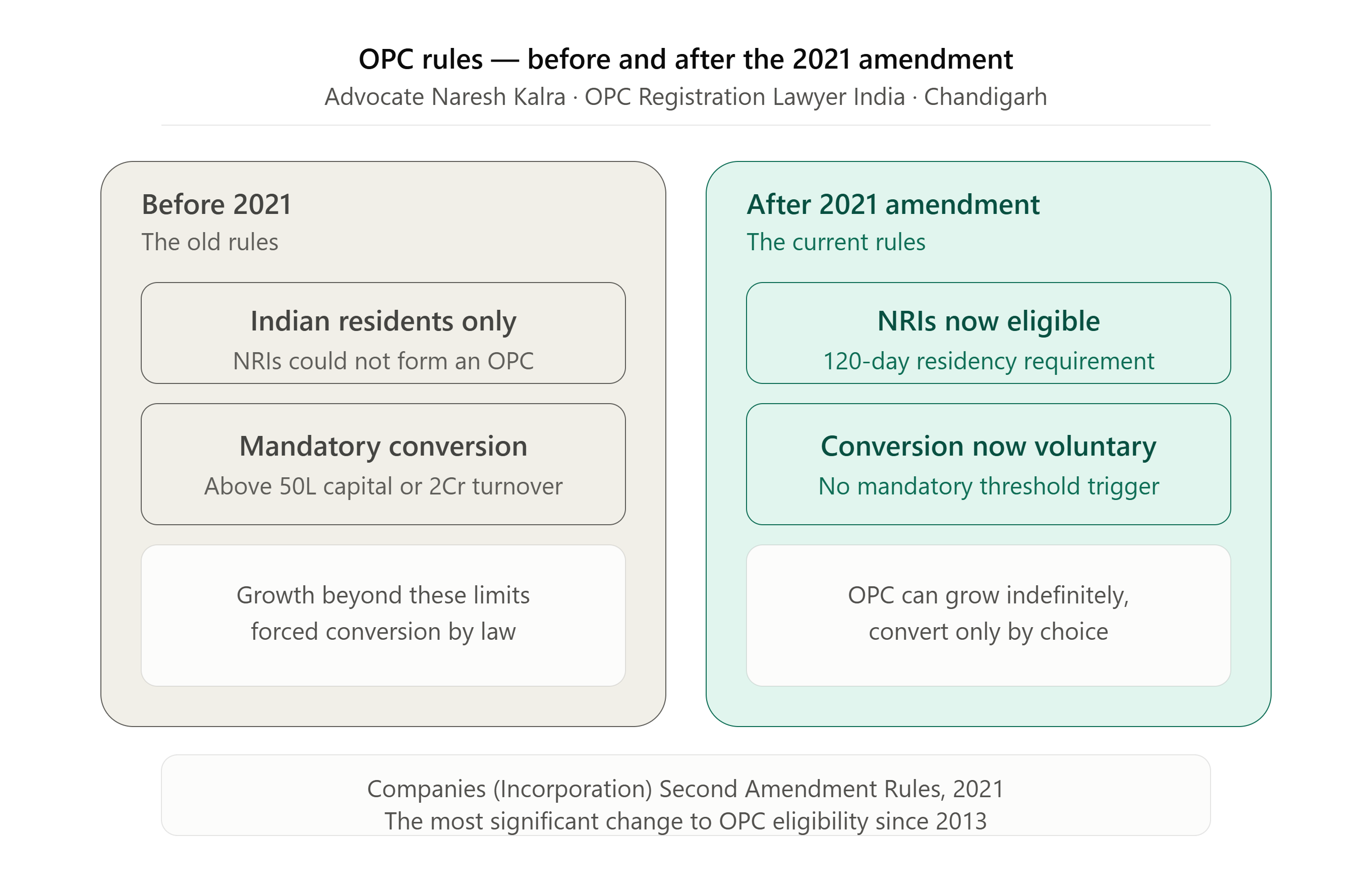
Yes. Following the Companies (Incorporation) Second Amendment Rules, 2021, Non-Resident Indians are now permitted to incorporate an OPC, with the residential requirement reduced to 120 days in the preceding financial year for NRI promoters, compared to 182 days for resident Indian promoters. Our OPC Registration Lawyer India team in Chandigarh advises NRI entrepreneurs on this pathway, which has opened OPC formation to a significantly wider pool of founders.
No — not anymore. Prior to 2021, OPCs were mandatorily required to convert into a private limited company once paid-up capital exceeded ₹50 lakh or turnover exceeded ₹2 crore. The Companies (Incorporation) Second Amendment Rules, 2021 removed this mandatory conversion trigger entirely. An OPC can now grow indefinitely while remaining an OPC, and conversion to a private limited company is purely a voluntary business decision — typically made when the founder wants to raise equity funding, which OPCs cannot do since they cannot issue shares.
The core difference is liability protection and legal identity. A sole proprietorship offers no separation between the owner and the business — personal assets are fully exposed to business debts. An OPC creates a genuine separate legal entity with limited liability, shielding personal assets, while still allowing single-person ownership and control. Our OPC vs Sole Proprietorship advisory helps founders in Chandigarh and Ludhiana weigh the modest additional compliance of an OPC against this significant liability protection.
OPCs face a structural limitation here, similar to LLPs — since an OPC cannot issue shares to multiple shareholders, traditional venture capital or private equity funding is generally not accessible in the OPC structure. OPCs can still access business loans and certain funding instruments more easily than an unregistered sole proprietorship. Businesses planning to raise institutional equity eventually convert to a private limited company — a voluntary decision, not a legal requirement, following the 2021 amendment.
OPCs are barred from engaging in financial sector activities — including operating as a Non-Banking Financial Company (NBFC), insurance business, or investment company. This restriction was not affected by the 2021 amendment and remains a firm structural limitation. Our OPC Registration Lawyer India team in Chandigarh advises founders in regulated sectors on whether an OPC or an alternative structure better fits their specific business activity.
An OPC offers real strategic advantages for solo entrepreneurs — limited liability, corporate credibility, and business continuity — all while preserving full ownership control. With the 2021 amendment removing mandatory size-based conversion and opening the door to NRI founders, the OPC structure is more accessible and flexible today than ever before.
The Law Offices of Advocate Naresh Kalra, with offices in Chandigarh, Mohali, and Ludhiana, are ready to guide your OPC formation from your first filing through years of ongoing compliance.