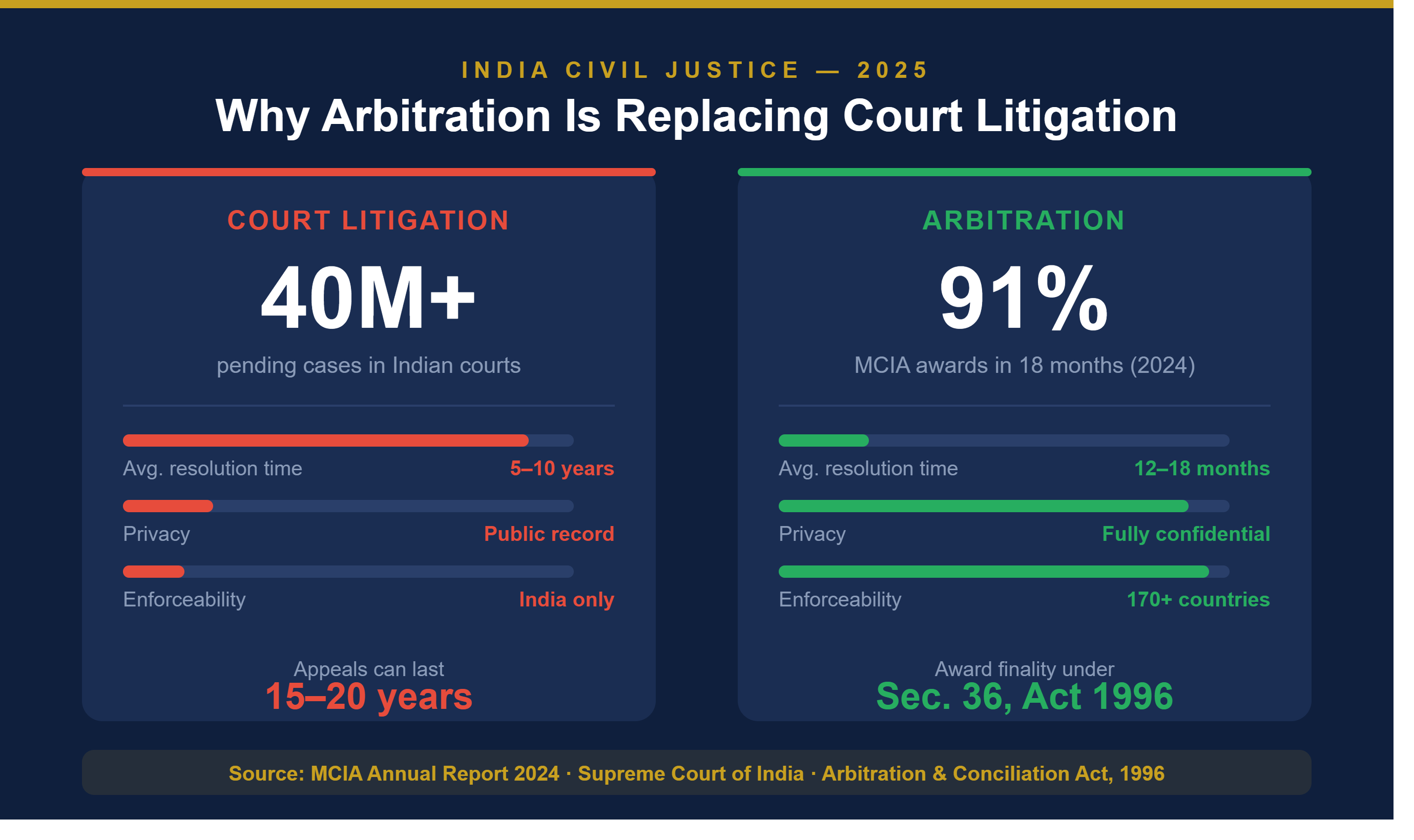
India now has over 40 million pending court cases — and businesses, property owners, MSMEs, and entrepreneurs across the country are done waiting. The fastest, most private, and most enforceable path to resolving a civil or commercial dispute in India today is arbitration — but only when handled by an expert arbitration lawyer in India who knows exactly how to win.
From a ₹5 lakh MSME payment dispute to a ₹500 crore infrastructure contract conflict, the right civil advocate for arbitration determines whether you get a binding award in 12 months — or lose years to procedural errors. This guide tells you everything: what arbitration is, how the process works, what separates top arbitration lawyers from average ones, and how to find the best arbitration lawyer in India for your specific dispute.
Arbitration is a formal, private dispute resolution process governed by the Arbitration and Conciliation Act, 1996, as amended in 2015 and 2019. A neutral third party — the arbitrator — hears both sides and issues a legally binding, enforceable award. Unlike court judgments, arbitral awards are final, confidential, and enforceable in 170+ countries under the New York Convention.
Key fact: A 2024 MCIA Annual Report showed 91% of MCIA-administered awards were delivered within 18 months, with none set aside by courts — proof that institutional arbitration with expert legal representation delivers results.
India's commercial courts, despite the Commercial Courts Act 2015, still face severe backlogs. A High Court commercial dispute can take 5–10 years. Arbitration, by contrast, delivers resolution in 12–18 months — with full confidentiality. Here is the head-to-head comparison every business should know:
| Factor | Court Litigation | Arbitration |
|---|---|---|
| Time to Resolution | 5–10 years (High Court) | 12–18 months (institutional) |
| Privacy | Public record | Fully confidential |
| Enforceability | India only (court decree) | 170+ countries (New York Convention) |
| Flexibility | Rigid procedural rules | Parties set rules, choose arbitrator |
| Arbitrator Expertise | General judge | Industry expert arbitrator possible |
| Finality | Multiple appeal levels | Limited challenge grounds (Sec 34) |
| Cost (Overall) | High (long timeline) | Lower (compressed timeline) |
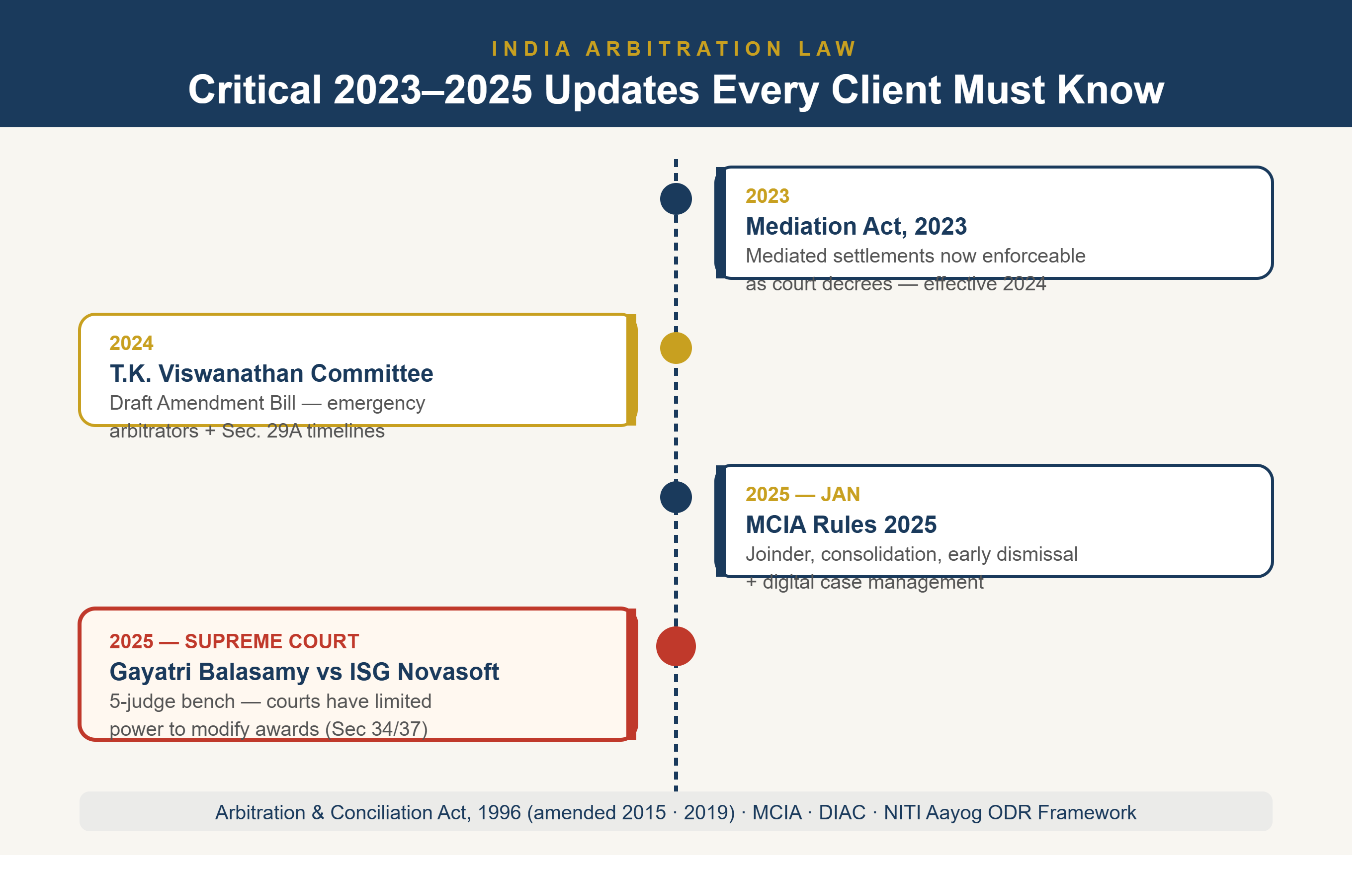
The legal landscape for arbitration in India is changing fast. A top arbitration lawyer in India must be current on all of these — and so should you:
Many clients hire a general civil advocate for arbitration — and regret it. Arbitration is not litigation; it has its own procedural law, evidence standards, drafting requirements, and strategic framework. Here is what India's best arbitration lawyers do differently:
The arbitration clause is the map for the entire dispute. A skilled civil advocate for arbitration in India reads it for: seat and venue of arbitration, governing law, number and method of arbitrator appointment, scope of arbitrable disputes, pre-arbitration notice requirements, and institutional vs. ad hoc rules. A vague or defective clause can make your entire claim procedurally vulnerable — before you even get to the merits.
Choosing the right arbitrator is arguably the most decisive factor in Indian arbitration. Top arbitration lawyers in India know which retired judges or domain experts are best suited for construction disputes, IT contract conflicts, or corporate shareholder matters. Under Section 11, if parties fail to agree, the relevant High Court or designated institution appoints — making early strategic agreement essential.
Most arbitrations are won or lost on paper — in the Statement of Claim or Statement of Defence — before a single oral hearing takes place. India's best arbitration lawyers draft with surgical precision: clear legal claims, properly authenticated documentary evidence, quantified relief, and airtight factual chronologies that leave no procedural gaps.
Interim relief — asset freezing, injunctions, protection of bank guarantees, status quo orders — can be the most decisive tactical move in Indian arbitration. Your advocate applies under Section 17 before the tribunal (once constituted) or Section 9 before the High Court (before or during arbitration). Getting or blocking interim relief early often determines whether the other party settles or fights.
Top arbitration lawyers treat evidence like a surgical instrument — not a stack of documents. Clean email trails, authenticated work orders, expert reports from credible professionals, properly sworn witness affidavits, and structured cross-examination plans. Sloppy evidence handling is the single biggest cause of strong cases producing weak awards.
Winning the award is step one. Collecting on it is step two — and often harder. India's best arbitration lawyers plan for enforcement from day one: ensuring the award is properly reasoned, the claim is precisely quantified, and the award is structured to withstand a Section 34 challenge. Post-award, they enforce under Section 36 or defend enforcement with precision.
India's top civil advocates for arbitration handle disputes across every major sector:
| Dispute Type | Common Scenarios | Relevant Law |
|---|---|---|
| MSME & Supply Chain | Payment defaults, supply delays, vendor disputes | MSMED Act + Arbitration Act |
| Construction & Infrastructure | EPC delays, variation claims, cost escalation | FIDIC, Indian Contract Act |
| Real Estate & Property | Builder-buyer, RERA-linked, co-ownership | RERA, Transfer of Property Act |
| Corporate & Shareholder | JV disputes, shareholder oppression, M&A | Companies Act, Arbitration Act |
| IT & Technology | SaaS disputes, software delivery, IP licensing | IT Act, Indian Contract Act |
| Banking & Finance | Loan recovery, guarantee enforcement, NBFC | SARFAESI, Arbitration Act |
| Employment | Wrongful termination, non-compete, severance | Contract Act, ID Act |
| International Arbitration | Cross-border contracts, foreign award enforcement | Arbitration Act Part II, NY Conv. |
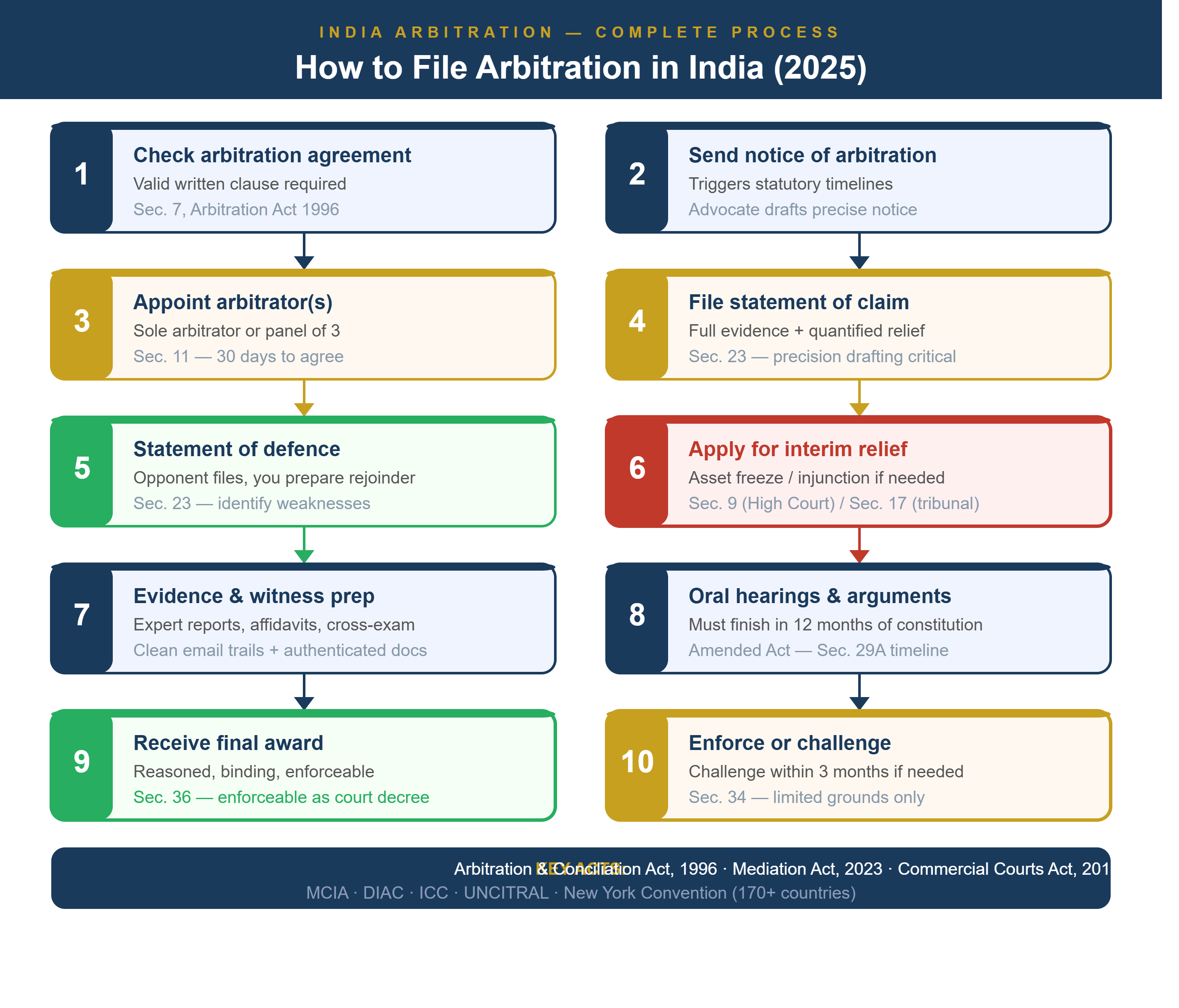
One of the most searched queries in India is "how to file arbitration in India" — here is the exact, complete process:
Not all civil advocates are equipped for arbitration. Use this checklist when searching for the best arbitration lawyer in India:
The Arbitration and Conciliation Act, 1996 is India's primary law governing both domestic and international commercial arbitration. It has been amended in 2015 (to reduce court interference and add fast-track arbitration) and 2019 (to promote institutional arbitration and add confidentiality obligations under Section 42A). A further amendment bill was proposed in 2024 based on the T.K. Viswanathan Committee report.
Yes. An arbitral award passed under the Arbitration and Conciliation Act, 1996 is legally binding and enforceable as a court decree under Section 36. It can be challenged only on limited grounds — patent illegality, conflict with public policy, fraud, or arbitrator incapacity — under Section 34, and only within 3 months of receiving the award.
Costs include: advocate fees (₹50,000 to several lakhs depending on complexity and seniority), arbitrator fees (based on claim value and institutional schedules), institutional administration fees (if MCIA, DIAC, or ICC is used), and venue costs. Proud Legal advocates provide transparent, written fee structures before engagement — no hidden charges.
Under the amended Arbitration and Conciliation Act, domestic arbitral tribunals must deliver an award within 12 months of completing pleadings, extendable by 6 months with party consent and court approval. MCIA reported 91% of awards delivered within 18 months in 2024. Ad hoc arbitrations without institutional management take longer.
Yes. Online Dispute Resolution (ODR) is formally supported by India's NITI Aayog policy framework and the IT Act, 2000. Virtual hearings, digital evidence submission, online arbitrator appointments, and e-signatures on pleadings are all legally valid. Proud Legal advocates are fully equipped for online arbitration proceedings.
Non-arbitrable disputes in India include: criminal matters, matrimonial disputes (except financial settlements by consent), insolvency and winding-up proceedings under IBC, testamentary matters, consumer disputes where consumer chose consumer forums, and disputes involving rights in rem (rights against the world). Your advocate will assess arbitrability before advising on strategy.
Domestic arbitration (Part I of the Arbitration and Conciliation Act, 1996) governs disputes where both parties are Indian entities and the seat is in India. International commercial arbitration involves at least one foreign party or is seated outside India (Part II governs enforcement of foreign awards under the New York Convention). International arbitration typically involves institutional rules like ICC, SIAC, or LCIA and requires advocates with cross-border legal expertise.
A party can challenge an award under Section 34 of the Arbitration and Conciliation Act within 3 months of receiving it. Grounds are strictly limited: incapacity, invalid arbitration agreement, improper notice, excess of jurisdiction, improper tribunal composition, non-arbitrability, or conflict with Indian public policy. Challenging on merits alone is not permitted — which is why getting the case right from the start is essential.
Proud Legal is India's trusted platform for verified civil advocates for arbitration — with pan-India coverage and transparent, expert-matched Regulatory and Compliance Issues:
India's arbitration landscape in 2025 is more active, more sophisticated, and more consequential than ever. Supreme Court rulings are reshaping enforcement strategy. Institutional arbitration centres are reporting record caseloads. The Mediation Act is creating new pre-arbitration settlement pathways. And the best civil advocates for arbitration in India are the ones keeping pace with every development — and using it to their clients' advantage.
Whether you are a first-time arbitration claimant or a business defending a complex multi-crore award challenge, the right arbitration lawyer in India — found through Proud Legal — gives you the strategy, precision, and confidence to achieve the outcome your case deserves. Do not wait for a dispute to become a crisis. Consult a verified civil advocate for arbitration today.