What is the difference between filing under the Domestic Violence Act and Section 85/86 BNS?
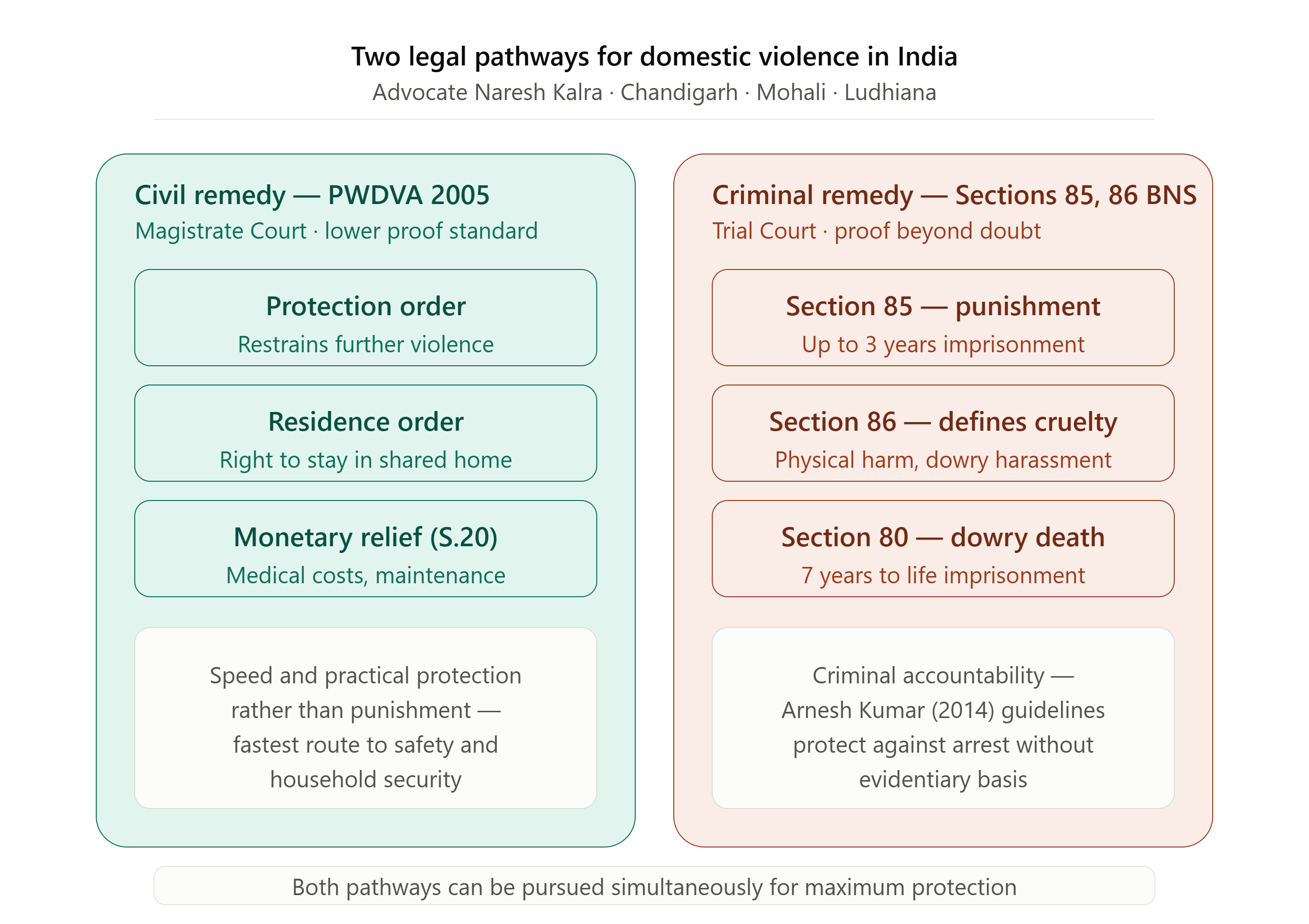
The Protection of Women from Domestic Violence Act, 2005 (PWDVA) is a civil law providing fast protection orders, residence rights, and monetary relief through Magistrate Courts, with a lower standard of proof. Section 85/86 BNS 2023 (formerly Section 498A IPC) is a criminal provision prosecuting cruelty, requiring proof beyond reasonable doubt, and carrying imprisonment up to 3 years upon conviction. Our Domestic Violence Lawyer India team in Chandigarh often pursues both simultaneously, since they address different needs — immediate protection versus criminal accountability.
Can a false Section 85/86 BNS case be quashed?
Yes. Where an allegation is demonstrably false, exaggerated, or lacks evidentiary foundation, our Marital Cruelty Defence Lawyer India team can pursue quashing of the FIR before the High Court under its inherent powers, particularly where the complaint discloses no cognizable offence or where parties have reached genuine settlement. Following Arnesh Kumar vs State of Bihar (2014), courts also scrutinize arrests in these cases carefully — arrest is not automatic upon FIR registration.
How do I get maintenance from my husband in India?
Maintenance can be claimed under Section 144 of the BNSS 2024 (formerly Section 125 CrPC) for wives, children, and dependent parents, or under Section 20 of the PWDVA for monetary relief connected to domestic violence proceedings. The amount is determined based on the husband's income and the applicant's reasonable needs. Our Maintenance Case Lawyer India team in Chandigarh and Ludhiana pursues fair maintenance awards and represents payers seeking reasonable determinations.
What protection can I get immediately if I am facing domestic violence?
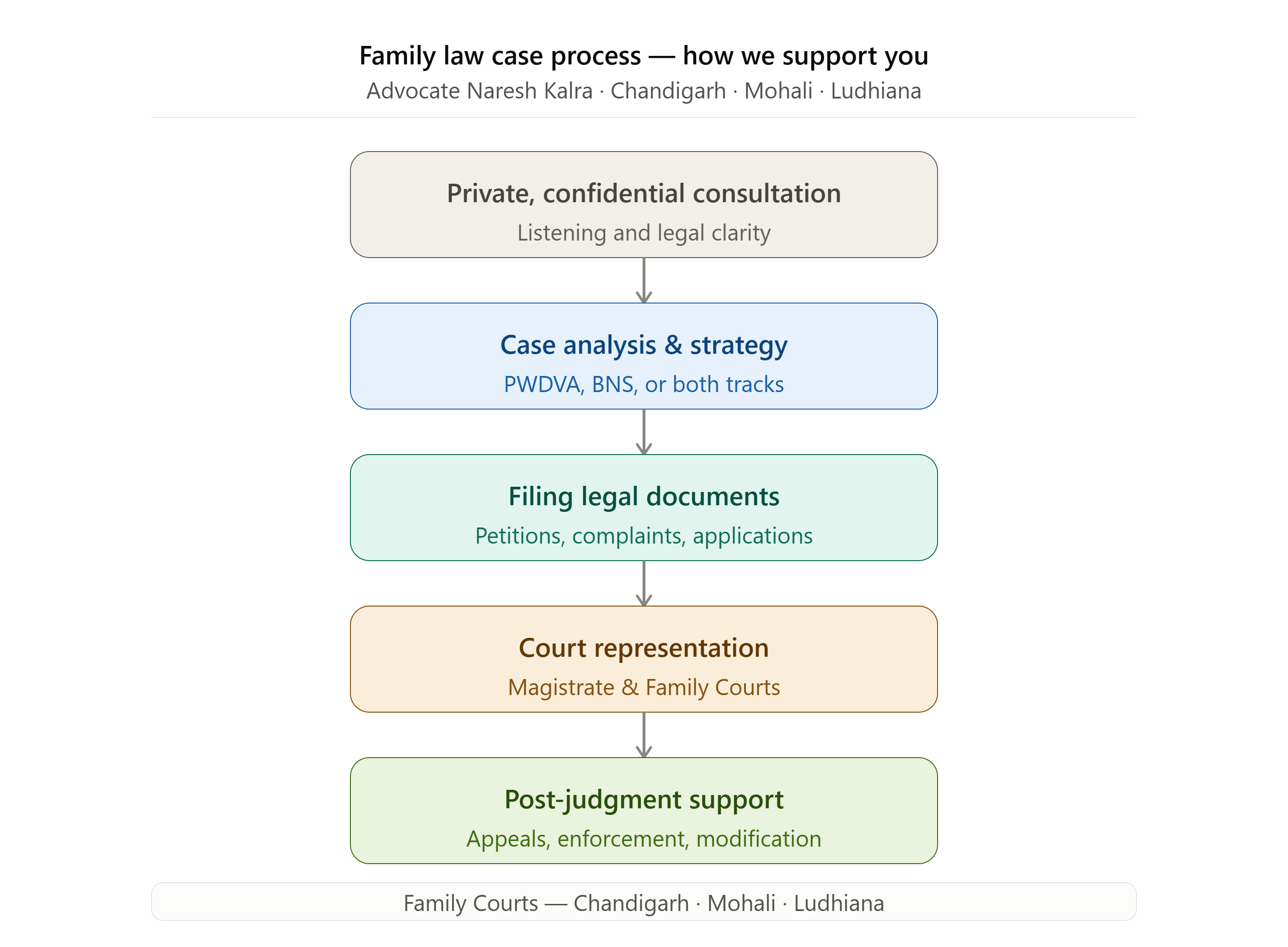
Under the PWDVA 2005, you can approach a Magistrate for an immediate Protection Order restraining further violence or contact, and a Residence Order securing your right to stay in the shared household regardless of property ownership. In cases of immediate physical danger, police can also be involved directly. Our team in Chandigarh, Mohali, and Ludhiana prioritizes urgent filing where safety is at risk.
What is the punishment for dowry death in India?
Dowry death under Section 80 of the BNS 2023 (formerly Section 304B IPC) applies where a woman's death occurs within 7 years of marriage under circumstances connected to dowry-related cruelty or harassment. It carries a minimum sentence of 7 years imprisonment, extendable to life imprisonment. These are among the most serious cases our Domestic Violence Lawyer India team handles, requiring both compassionate representation for grieving families and, where applicable, meticulous defence.
Who gets custody of children after separation in India?
Custody decisions prioritize the welfare of the child above all else, considering factors like the child's age, each parent's ability to provide stability, and, for older children, their own preference. The applicable law depends on religion and circumstances — the Guardians and Wards Act 1890 applies generally, while Hindu families may also invoke the Hindu Minority and Guardianship Act 1956. Our Child Custody Lawyer India team in Chandigarh represents both mothers and fathers, always centering the child's genuine wellbeing in case strategy.